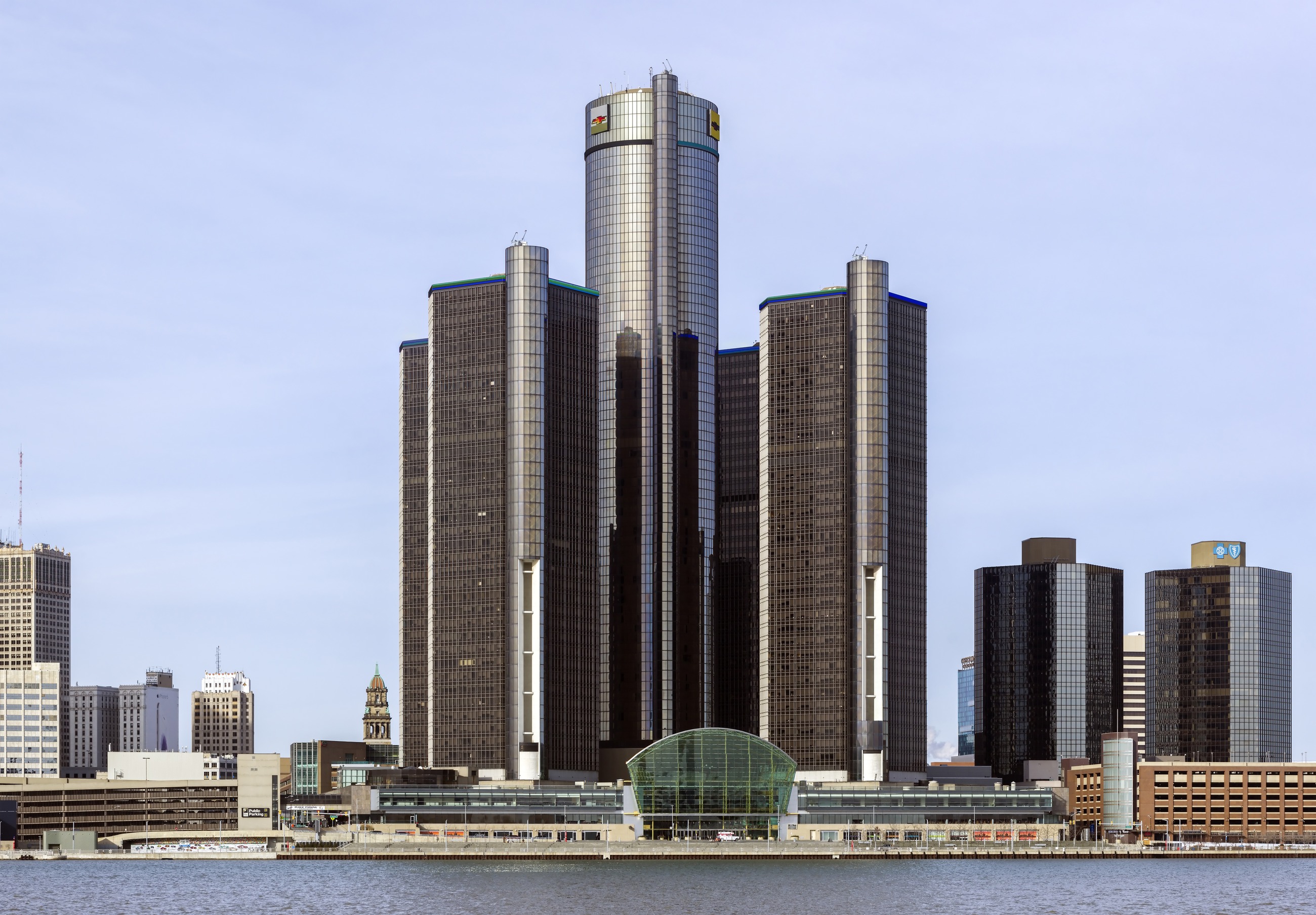
Tower 300 of the Renaissance Center was 100 percent leased at the end of 2022. It's one of the two towers General Motors and Bedrock want to take down. Tower 400, the other, was 98.9 percent leased, and Tower 200, which the plan keeps as offices, was 36.4 percent leased.
A signed lease isn't a worker at a desk. Between 2018 and 2023, GM cut its RenCen headcount by more than half and moved much of its white-collar staff to its Tech Center in Warren. GM stayed until January 2026, and the company began moving its offices to Hudson's Detroit, on Woodward Avenue, on January 12, 2026. Lee Wasik, assistant general manager of Joe Muer Seafood inside the RenCen, had heard it was coming for a while. "I saw them starting to take away the GM signage and all the statues that were for GM," he said that day.
Bedrock released the plan on November 25, 2024. Towers 300 and 400, the two 39-story towers nearest the river, would come down with the low-rise base of the complex to make six acres of riverfront park. Tower 100 would become housing, and the top 20 floors of the 73-story Marriott would turn into apartments, cutting the hotel from 1,200 rooms to 850. The price was $1.6 billion, with $1 billion from Bedrock, $250 million from GM and $250 million in public money. "For the first time in 50 years, you'll be able to walk right up to the front door of the towers," said Jared Fleisher, Bedrock's CEO, at the Detroit Policy Conference in January 2025.
The Downtown Development Authority voted unanimously in November 2025 to commit $75 million, $20 million to reimburse Bedrock for demolishing the podium and $55 million for the public space, paid out from 2027 to 2033. That commitment depended on the Legislature extending the state's Transformational Brownfield program by March 31, 2027. Governor Whitmer signed a law in July 2026 that doubles the cap on that state tax break, from $1.6 billion to $3.2 billion. Dylan Wegela, a Democratic state representative from Garden City, voted against it, and Preservation Detroit and the Michigan Historic Preservation Network opposed any demolition.
Ford built it. Henry Ford II convened a 26-member coalition called Detroit Renaissance in 1971, and more than 40 companies invested in the partnership, Chrysler among them with $1.5 million. Ford itself occupied one of the office towers for the first 19 years. Atlanta architect John Portman designed the first five buildings, which cost $350 million. The first tower opened on July 1, 1976, and the hotel opened in 1977 as the tallest in the world.
The name came out of a 1973 contest with 141,537 entries. Roger Lennert, the winner, didn't know he had entered, because his mother sent in the entry for him.
The complex cut itself off from downtown. Massive concrete walls along Jefferson Avenue made it look like a fortress, and many workers drove in from the suburbs, parked in an attached garage and crossed a skybridge without ever setting foot on a downtown street. GM bought the RenCen in 1996 for $73 million, about $144 million in 2024 dollars, and finished moving in from New Center in 2000. Its renovation cost $500 million. The biggest piece came in 2001, when GM opened the five-story Wintergarden toward the river and tore down the walls on Jefferson for a new entrance. The work was done in 2004.
Bedrock and GM are taking comments through an online survey and an engagement center at Beaubien Place, 521 Atwater Street. It's open Wednesday to Friday from 11 a.m. to 6 p.m. and on Saturdays from 11 a.m. to 4 p.m.