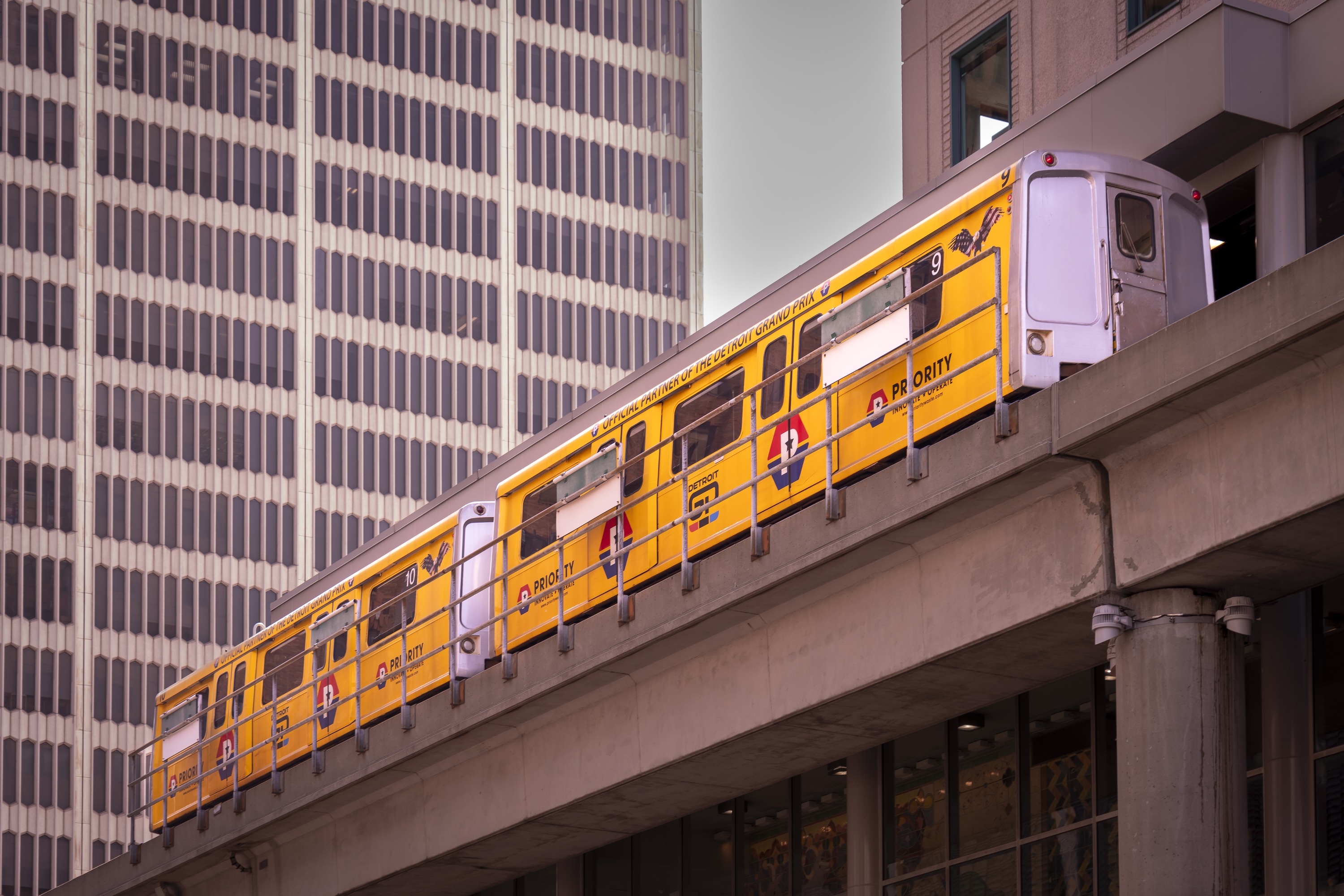
The DTC plans to replace the People Mover's fleet with 12 used railcars from Toronto's retired Scarborough RT, refurbished in the 2010s, the first due in 2027. UTDC of Kingston, Ontario built the loop with the same linear-induction trains as Vancouver's SkyTrain and Toronto's Scarborough RT. In 2027 the Financial District station takes Coleman Young's name, and the train he rode first turns 40.
On July 31, 1987, a train with nobody at the controls broke a green ribbon over downtown Detroit and started its first lap. Mayor Coleman Young cut a five-foot cake shaped like a People Mover car and rode the first run while 10,000 balloons went up. Rides were free for a week, then 50 cents from August 8.
The People Mover is a 2.9-mile loop with thirteen stations, no driver and one direction, about 15 minutes a lap. It was drawn up as the downtown end of a regional rail network. SEMTA's 1974 plan called for eight subway lines, 75 miles of track and 63 stations, with people movers downtown, and in October 1976 the Ford administration committed $600 million to it. Local leaders never agreed on a plan, and the Reagan administration withdrew the money.
Only the loop went ahead. Ground broke on October 31, 1983. Priced at $134 million, it cost more than $224 million by opening day, and delays and the unproven driverless technology were blamed for the overrun.
Volunteers raised $2 million so every station opened with real art. Eighteen new works went in, plus a 1903 Carlo Romanelli bronze at Cadillac Center, and Pewabic made tile for four stations. The green tiles at Cadillac Center had sat in storage since the 1930s, made for a Stroh Brewery expansion that never happened, until Peter Stroh donated them.
Planners had projected 67,700 riders a day. The first year averaged 11,000 riders a day, and the one-day record, 54,648, came in that first year too. By 2008 the loop drew about 7,500 a day and was running at about 2.5 percent of its capacity, and Detroit called it the Person Mover. The fare stayed at 50 cents until November 2011, when it went to 75.
In August 2008, after a short closure to replace sections of track, the trains turned around to run clockwise. Run that way, the route has one steep climb and then runs downhill most of the way, which cut the time between the busy stations. Trains still arrive every eight minutes or less.
The DTC board approved a one-year free-fare pilot in December 2023, and the ride has been free since January 2024. Priority Waste of Clinton Township became presenting sponsor in March 2024. Ridership for 2024-25 came to 1.32 million, up 23 percent, 250,000 more riders than the year before. The pilot ran through 2025, and the ride was still free in 2026.
Wind shut the loop for nearly two months in the spring of 2026. Severe winds blew debris onto the track on March 13 and damaged track equipment. The trains were running again on May 6, still free.
Photo: A two-car train on the loop, 2024, Mobilus In Mobili via Wikimedia Commons, CC BY-SA 4.0