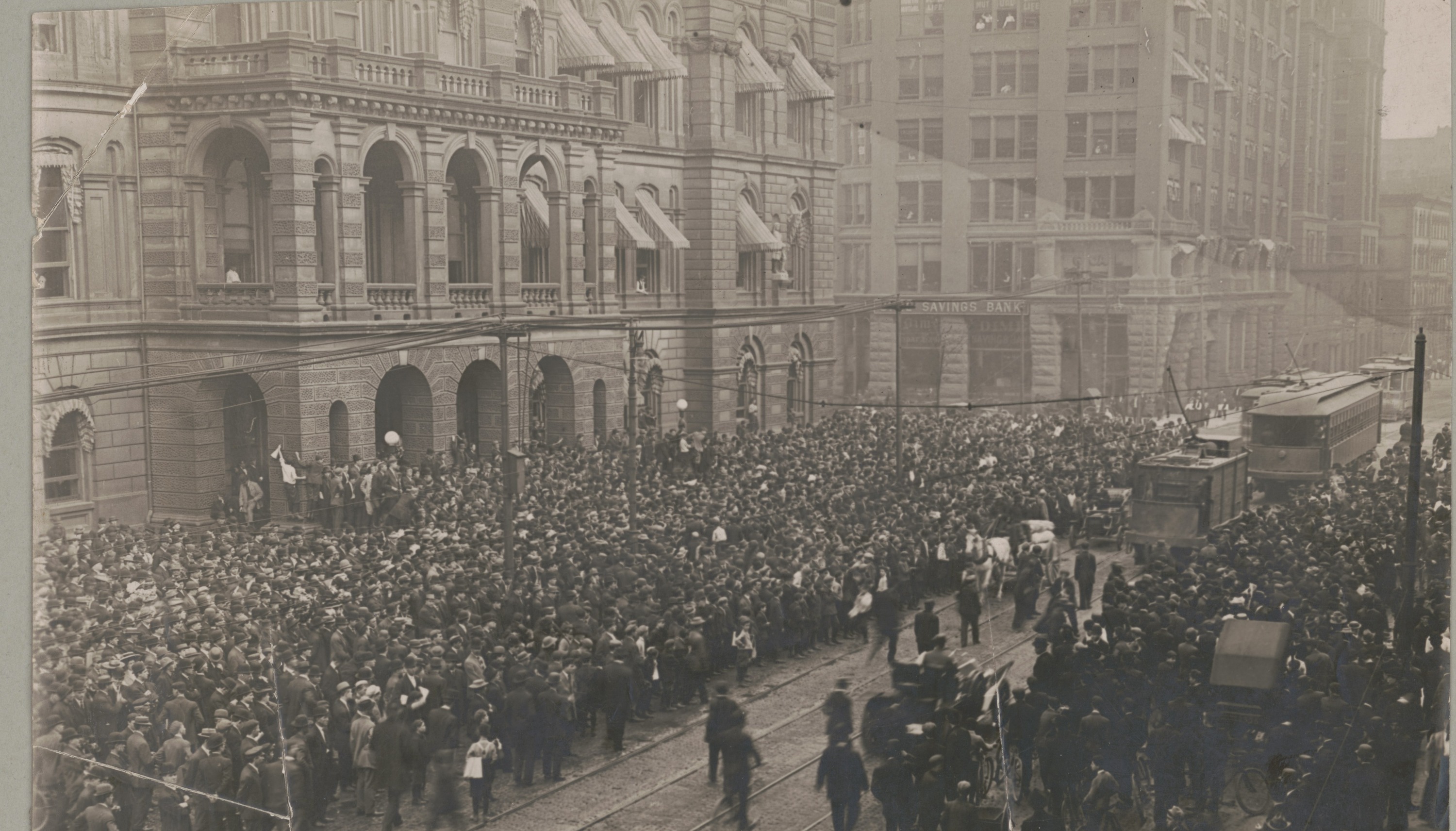
Winding the clock on Detroit's City Hall meant a city worker taking 1,512 steps on a treadmill, until electricity took over in 1884. The clock was the work of W.A. Hendrie of Chicago, with four dials 8 feet 3 inches across made in Glasgow, and when its 125-pound pendulum first swung on July 4, 1871, it was the largest clock in the country. Almost every year since 1871, the booming of the 7,670-pound bell on New Year's Eve summoned hundreds of couples to City Hall, where they kissed at the stroke of midnight.
Detroit threw the new hall a party that July 4, 1871. The day began at 7 a.m. in the rain with the ringing of the bell. Mayor William W. Wheaton presided, a procession marched up Woodward, and the Declaration of Independence was read from the front steps. A gun salute went off, rockets were fired from the clock tower, and fireworks closed the night from the lawn. All in, the hall cost $602,130.
Architect James Anderson had the plans ready in 1861. The Civil War held up materials, the foundation went in in 1867, and N. Osborn & Co. of Rochester finished two months early. The building ran 200 by 90 feet, three floors of cream Amherst sandstone, with a clock tower 180 feet up, the highest point in the city. It predated Detroit's first skyscraper by nearly two decades.
Detroit had about 80,000 people when the hall opened and 1.5 million by 1926, and eight presidents came through it. The Common Council's 4,370th and last session there was July 19, 1955. Two days later Mayor Albert Cobo led a parade of officials to the new $26 million City-County Building.
By the 1950s people called the old hall ugly. Mayor Louis Miriani, who took over when Cobo died in 1957, had called the hall and its lawn "a mess" in 1956 and said perhaps "the city should tear the place down and move the tenants elsewhere." Minoru Yamasaki, the architect tapped to plan a park for the site, called it "a very ugly building."
Detroiters disagreed. A Survey Associated poll of 2,500 of them found 58 percent wanted the hall saved and 21 percent wanted it razed. City Planning Director Charles Blessing recommended saving it on November 30, 1960. Two days later Miriani called him in, and Blessing reversed himself. Emil Lorch, the former dean of the University of Michigan architecture school and chairman of the Michigan Historical Society's architectural committee, put the case for the building this way as the city debated: "Demolishing Old City Hall seems to me like a piece of public vandalism, the act of some who now see their city great and rich and are a little ashamed of their ancestry."
The council voted 5 to 4 to wreck it. Save Old City Hall groups sued and lost all the way to the U.S. Supreme Court, which refused the case. Union Wrecking started at night on August 14, 1961, unannounced, with a 4,800-pound ball. The clock tower fell last, and by September 18 nothing was left but rubble.
The site became a concrete plaza over a parking deck, named Kennedy Square in 1964 for the president who spoke on the hall's steps in 1960. The One Kennedy Square office building rose on it in 2005. The four statues, Cadillac, Marquette, La Salle and Richard, went to Fort Wayne and then to Wayne State.
The bell that rang in the rain in 1871 was lowered to the ground on September 12, 1961, the first time in 90 years. Union Wrecking's president had it struck twice with a sledgehammer. It's at Fort Wayne now.