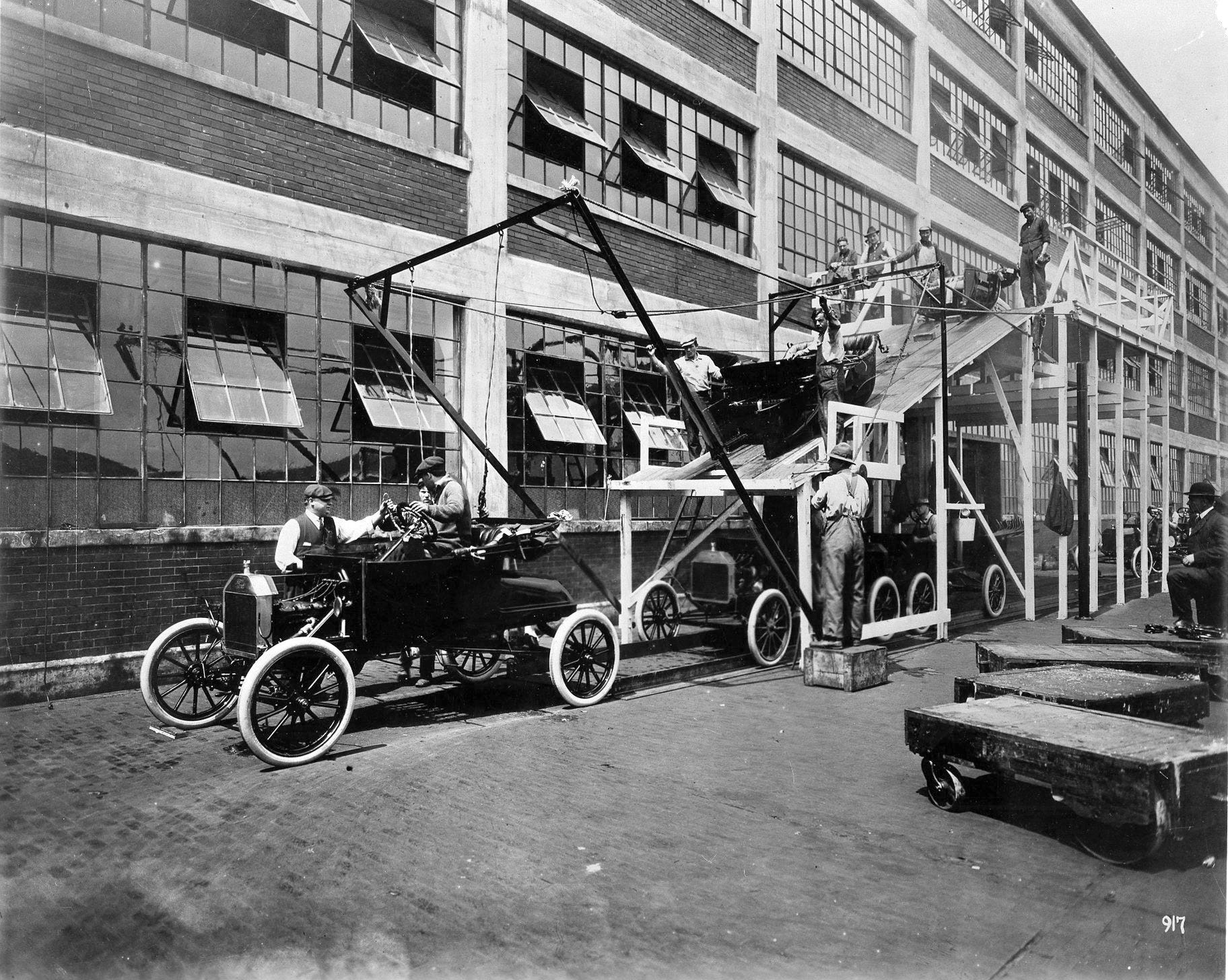
The moving line at Ford's Highland Park plant cut the time to build a Model T from 728 minutes to 93. On October 7, 1913, the assembly line there started moving. It was the first automobile production facility in the world to use a moving assembly line. The price kept falling with it, from $700 in 1910 to $350 in 1917, which put the car within reach of most Americans.
The plant itself was three years old. It opened on January 1, 1910, on Woodward Avenue at Manchester Street, on the site of the old Highland Park Hotel and a racetrack. About 102 acres in size, it was the largest manufacturing facility in the world at the time of its opening, with offices, factories, a power plant and a foundry. Albert Kahn designed a four-story factory running 865 feet parallel to Woodward, with a glass roof and walls of windows that got it the name the Crystal Palace. The extra light and ventilation made it a more pleasant place to work and left room for more machines and workers. The Model T had started in 1908 at the Piquette Avenue Plant, and Highland Park was the second factory to build it.
Then on January 5, 1914, Ford raised the daily wage from $2.34 to $5.00 and cut the shift from nine hours to eight. That was nearly three times what other unskilled manufacturing plants paid. Ford claimed the turnover rate of 31.9 percent in 1913 dropped to 1.4 percent by 1915.
In the 1920s automobile production moved to the new River Rouge Plant in Dearborn, though the Model T was assembled in Highland Park until 1927, when the 15 millionth car rolled off the line. After that the Model A began production at the Rouge. Highland Park went on making automotive trim, trucks and tractors, then built 1,690 Sherman tanks between June 1942 and September 1943.
Tractor production continued for decades. The power house, with its smokestacks that once held letters spelling Ford between them, was torn down in 1960 along with the Crystal Palace. All production at what remained of the facility ceased in 1974. Ford sold its building and began leasing the space in 1981, and through the 1980s parts of the factory were dismantled and torn down.
Ford used some of the buildings for record storage until 2012. In 2013 the Woodward Avenue Action Association bought two of the buildings, with the goal of a welcome center by 2018. Its purchase agreement with the owner put the price at $550,000 for the pair, a four-floor sales office and an executive garage.
The Highland Park Ford Plant was listed on the National Register of Historic Places in 1973 and named a National Historic Landmark in 1978. A plaque from the Michigan State Register of Historic Sites stands by the former Administration Building on Woodward.