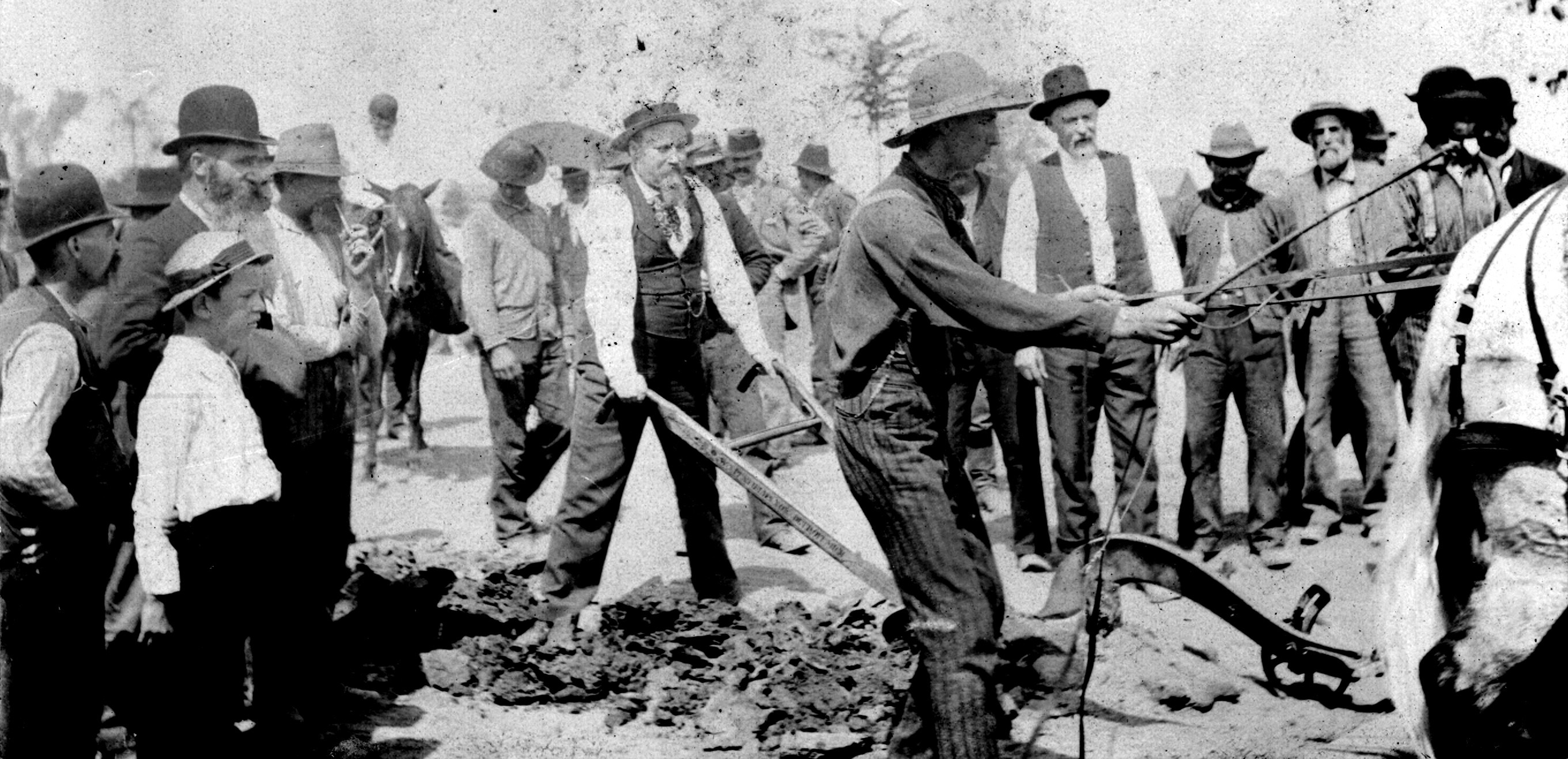
Hazen Pingree sold his prize horse to cover the farming tools and seeds, paying for the start of the potato patches himself. The patches let poor people use 430 acres of vacant city land to grow food. When the nationwide Panic of 1893 caused a severe depression, Detroit's mayor expanded the city's public welfare programs and started public works for the unemployed, and he built new schools, parks and public baths. His best-known answer to the Panic was the potato patch. The plan made him nationally known.
Pingree made shoes before he made policy. After the war he moved to Detroit, and in 1866 he and the accountant Charles H. Smith bought a Detroit shoe company's machinery. By 1886 Pingree & Smith was a $1 million business, the second largest in the country, with 700 workers turning out half a million pairs a year.
He won the mayor's office in 1889 after a colorful campaign in which he made a circuit of the saloons, running on a promise to expose and end corruption in city paving contracts, sewer contracts and the school board. Then he turned on the utility monopolies, building a city-owned lighting plant to undercut the electric company. His largest fight was with Tom L. Johnson, president of the Detroit City Railway, over lowering streetcar fares to three cents. Pingree tried to start a competing city-owned railway, but the Michigan Constitution barred it. Voters re-elected him three times.
He was born in Denmark, Maine, moved to Saco at 14 to work in a cotton factory, and two years later went to Hopkinton, Massachusetts, where he cut leather in a shoe factory. In 1862 he enlisted in the Union Army. Confederates captured him in May 1864, and he was held in prisons in Virginia and North Carolina and taken to Andersonville. From Millen, Georgia, he escaped that November by pretending to be someone else at a roll call for a prisoner exchange. He rejoined his regiment and was at Appomattox Court House when Lee surrendered on April 9, 1865.
The Republicans nominated him for governor in 1896, and he carried Michigan for himself and for William McKinley. He took office on January 1, 1897, intending to finish his term as mayor too. The Michigan Supreme Court ruled against him, and he resigned as mayor. As governor he pushed through the nation's first major statewide reappraisal of railroad and corporate property. Opposition from Democrats and business-oriented Republicans blocked most of his proposals.
He ran the state from 1897 to 1901. Coming home from an African safari, he fell ill with peritonitis in London, and King Edward VII sent his own doctors. He died there on June 18, 1901.
Common Detroiters sent in their pennies, nickels and dimes to pay for his statue. Rudolph Schwarz, an Austrian sculptor, made it, and it was unveiled in Grand Circus Park on May 30, 1904. A 1999 poll of scholars for Melvin Holli's The American Mayor put him among the ten best mayors the U.S. has had. The statue commemorates him as "The Idol of the People."