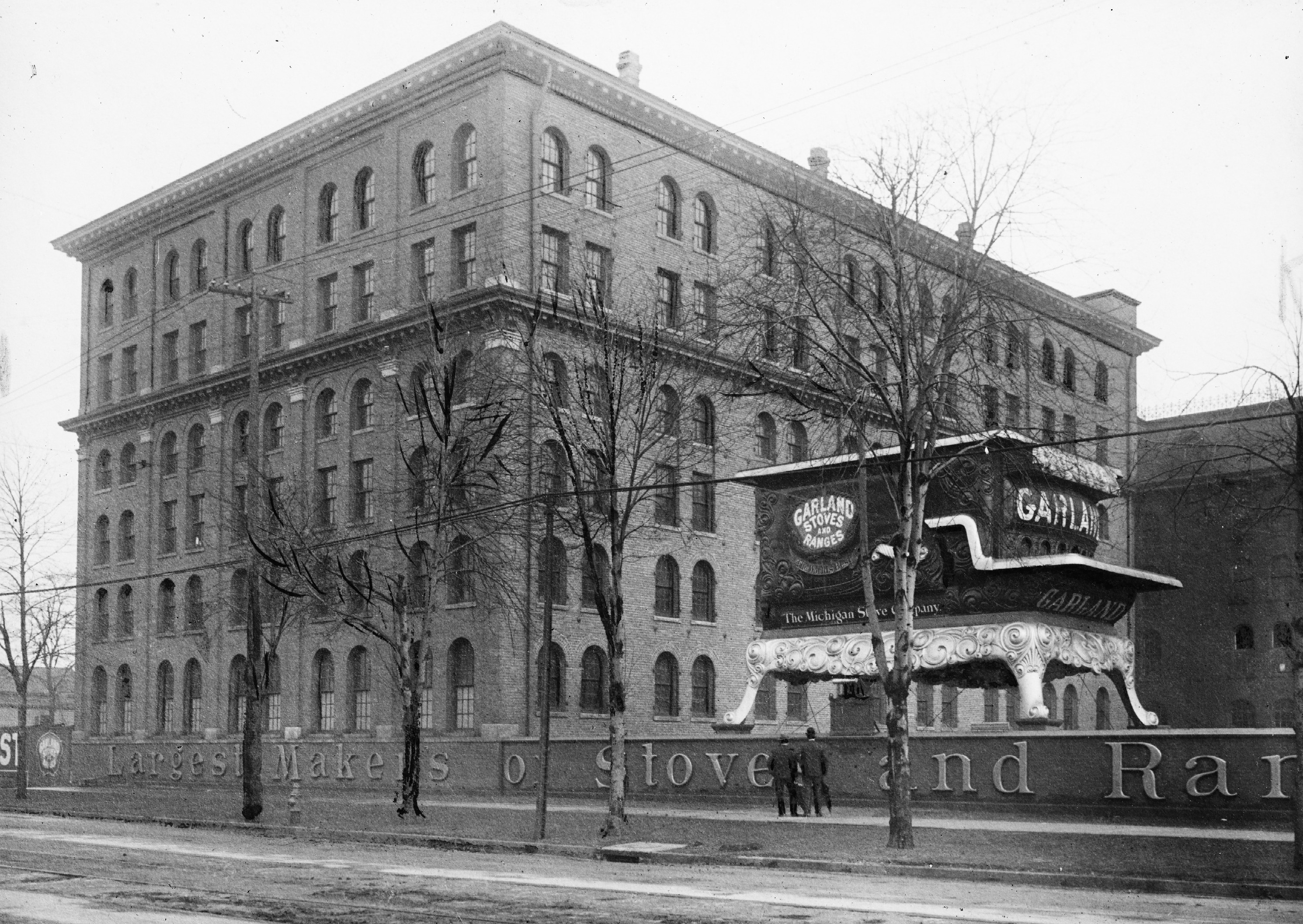
At 4:16 a.m. on April 11, 1965, the stove set out for the State Fairgrounds at 5 miles an hour. It was a Garland range 25 feet high, carved from wood. It had stood on East Jefferson for 72 years. The Don Carthage Co. lent the truck, and the route wound up Van Dyke and across McNichols to Woodward to dodge overpasses. Detroit Edison and Michigan Bell crews moved utility lines out of the way. A guy wire snapped and cracked a parked car's windshield. Crowds lined the route. The trip took nine hours.
The stove was an advertisement. Stoves were the city's leading industry before cars were. In the 1870s and 1880s, more than one in ten stoves made anywhere on earth came out of Detroit. Upper Peninsula iron ore came down the lakes once the Soo Locks opened in 1855, and Detroit foundries poured it into cast iron. Detroit was the Stove Capital of the World, and a Garland range ran from $10 to $70 in those days.
Three firms ran the trade: Detroit Stove Works, Peninsular and Michigan Stove, which sold its ranges under the Garland name and others. At East Jefferson and Adair, Michigan Stove employed 1,400 people, melted 65 tons of iron a day and shipped over 75,000 stoves a year. It called itself the biggest stovemaker in the world.
For the 1893 Chicago fair, Michigan Stove set out to prove it. William J. Kemp designed a Garland range 25 feet high with a large room beneath it, and a crew under Declan Shannon of Corktown carved it from pine, redwood and basswood. It ran 30 feet long and 20 feet wide and weighed about 15 tons. It took three railroad cars to get it to Chicago.
After the fair it came home to East Jefferson and went up outside the Michigan Stove plant at Jefferson and Adair. It survived a 1907 factory fire, and in 1927 it moved to the merged company's headquarters by the MacArthur Bridge, on new legs by John Tabuczuk. It stayed there until 1965, when the site was slated for a gas station and the stove, then 72 years old, had to go. That was the morning it went up Van Dyke.
The fairgrounds kept it for nine years. Millwrights volunteers took it apart in November 1974, and the Detroit Historical Society stored the pieces at Fort Wayne for nearly 25 years. State Fair manager John Hertel tracked it down. Crews stripped up to 20 layers of paint over three years of mostly donated work, and Gov. John Engler saw it rededicated on August 24, 1998.
Around 7 p.m. on Saturday, August 13, 2011, lightning hit the stove on the shuttered fairgrounds. Fire crews were called about 8 p.m., and it was declared a total loss. "The fire just wiped it out. I don't know if it would even be possible to rebuild it. That's a bummer," said Kurt Weiss, spokesman for the Michigan Department of Technology, Management and Budget.
The charred pieces went to the Detroit Historical Society, which still holds them.