Walter P. Chrysler's grandson was 12 when he broke ground on the freeway named for his grandfather. On January 30, 1959, Jack Forker Chrysler pulled the whistle cord on a diesel-powered shovel near Hastings and Macomb, on the eastern edge of downtown, and work on the Walter P. Chrysler Expressway began. The Detroit Board of Commerce had asked Mayor Albert Cobo in February 1957 to put Chrysler's name on what the plans called the Hastings-Oakland Expressway. The first stretch, from Larned Street to the Edsel Ford, opened on June 26, 1964.
The Edsel Ford got its name by ordinance. Councilman Charles E. Dorais introduced it on April 16, 1946, naming the proposed Crosstown Expressway for Henry Ford's only child, who was president of Ford Motor Company until 1943. Edsel had died of cancer three years earlier, at 49. A variety of names had been suggested, and the Common Council approved his unanimously on April 23. More than 2,800 buildings were demolished to build the road, and the losses fell hardest on poor Black neighborhoods.
John C. Lodge was a reporter and city editor at the Detroit Free Press from 1889 to 1896. His years on the Detroit City Council ran from 1910 to 1922 and again from 1932 to 1947, nine of those years as council president. In between he was mayor three separate times: 1922 to 1923, 1924, and 1927 to 1929. Pneumonia killed him on February 6, 1950.
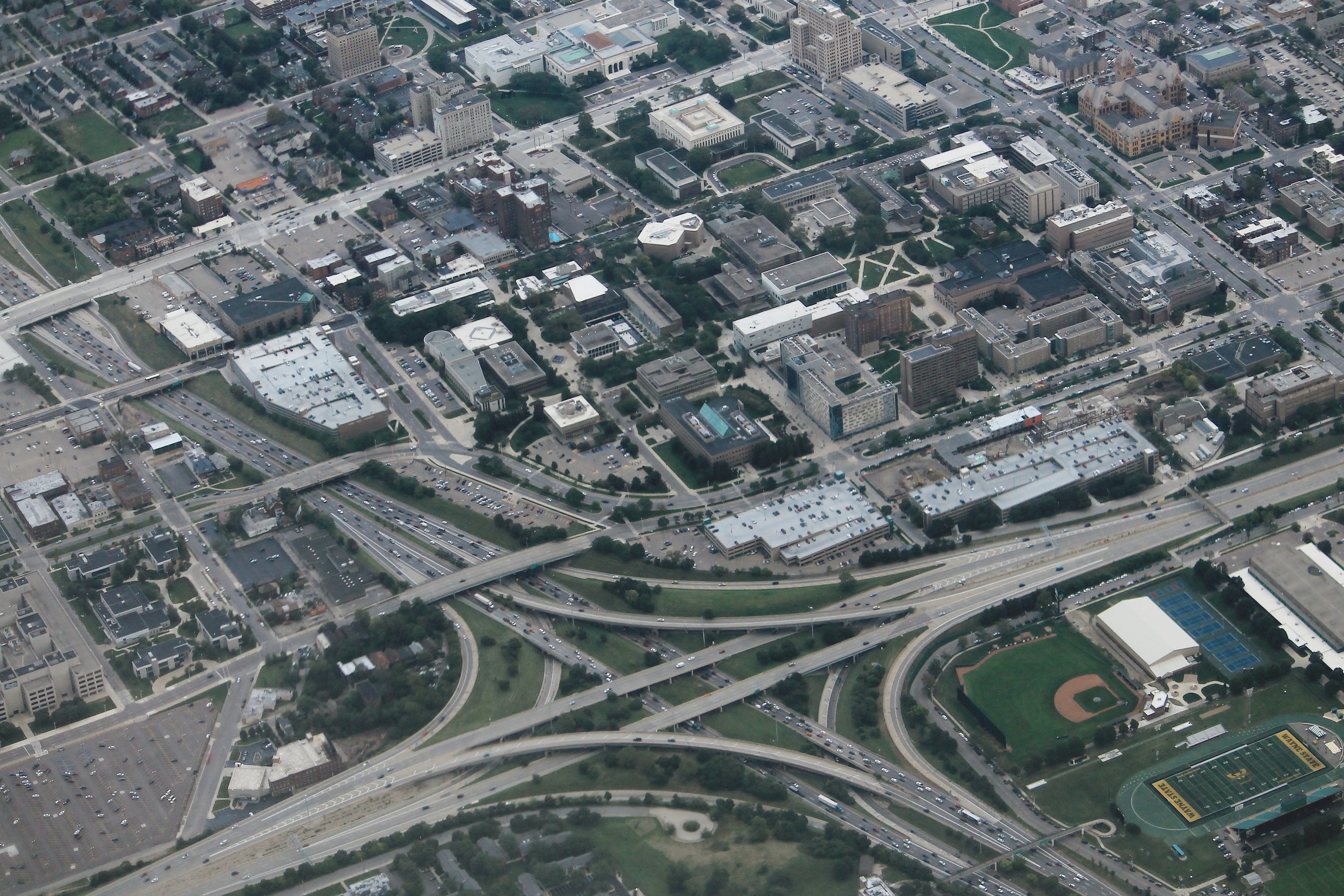
The Lodge was built in segments during the 1950s and 1960s. Its interchange with the Edsel Ford, built in 1953, was the first complete interchange between two freeways built in the United States. The whole route had been three segments, the Lodge, the James Couzens Highway and the Northwestern Highway, until 1987, when all of it was named the John C. Lodge Freeway. The service drives kept their original names.
The Fisher is seven brothers: Frederick J., Charles T., William A., Lawrence P., Edward F., Alfred J. and Howard A. They came to Detroit in 1908 and formed the Fisher Body Co., sold 60 percent of it to General Motors in 1919, and opened the Fisher Building at Second Avenue and Grand Boulevard in September 1928. The last stretch of their freeway inside the city, from Clark Street to 12th Street, now Rosa Parks Boulevard, opened at 10 a.m. on September 17, 1970.
The Jeffries carries the name of Edward Jeffries, Detroit's mayor from 1940 to 1948. Its final piece, from the Southfield Freeway through Redford Township and Livonia to I-275 near Plymouth, opened on November 21, 1977, after a 9:30 a.m. ribbon cutting at Inkster Road. In December 2005 the Legislature renamed the portion inside Detroit the Rosa Parks Memorial Highway, and the maps still call it the Jeffries.
One name belongs to a settler. The Davison Freeway is named for Jared Davison, an English immigrant and early settler whose farm bordered what became Davison Avenue. It opened on November 25, 1942, without a dedication ceremony, as the first urban, below-grade freeway in the United States. Travel time to and from Detroit dropped from about 15 minutes to three or four.
Walter P. Reuther was an early leader of the United Auto Workers, and I-696 carries his name for its whole length. Its first segment opened 26 years before its last. A seven-mile gap was left for almost 15 years between Telegraph Road in Southfield and I-75 in Madison Heights. The Michigan Department of Transportation has been slowly taking the Reuther's name off its signs.
Oak Park's Jewish community wanted the freeway moved around it so people could keep walking to temple on the Sabbath and religious holidays. Instead three parks were built on top of it, Victoria Park and Rothstein Park in Oak Park and Lincoln Woods Park in Southfield. The middle section opened at 5 p.m. on December 14, 1989, in time for the evening rush. At 6:21 p.m., three cars collided in the westbound lanes just east of Woodward Avenue in Royal Oak.
Photo: The Lodge meets the Ford at Wayne State, 2017, formulanone via Wikimedia Commons, CC BY-SA 2.0