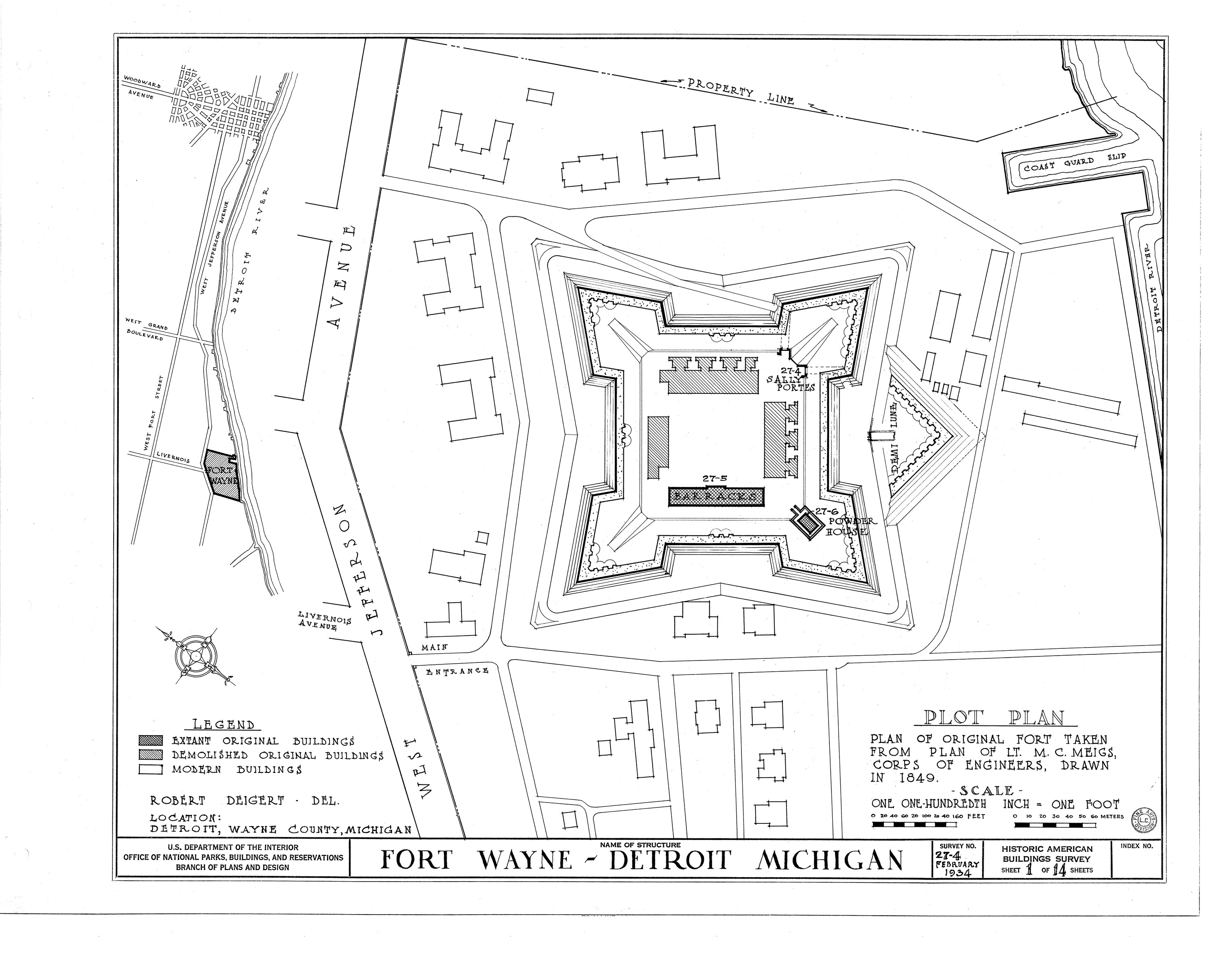
The star fort at Fort Wayne was to have had 56 guns, and none of the guns or their ammunition was ever provided. Its walls were built with fill from a burial mound. The Nottawaseppi Huron Band of the Potawatomi considers the star fort sacred because its walls likely hold ancestral remains.
The fort went up on the river at West Jefferson and Livernois in the 1840s to defend against a British attack, and it has never seen a shot fired in combat. The Army surveyed the narrowest point in the river between Detroit and British Canada in 1840. Congress passed an act on August 4, 1841, allowing a new fort near Detroit, three miles south of the old forts downtown. Lt. Montgomery C. Meigs, a West Point graduate and the superintending engineer from 1841 to 1849, designed it as a five-point star that could fire across to the Canadian shore. He later helped extend the U.S. Capitol and became Quartermaster General of the Union Army.
Meigs bought the site in 1842, and the earthworks waited until 1844 because more land was wanted. The barracks came next and were finished by the end of 1848. He designed them in five distinct parts with thick stone walls, so the whole building could not catch fire at once. General Orders No. 6 named the post for Gen. Anthony Wayne on January 31, 1849, and initial construction was completed in 1851 at a cost of $150,000.
By then the potential for conflict with Canada had lessened. After completion a single caretaker watched the fort. The city's own history lists the site as a station on the Underground Railroad and says research on that role is ongoing. Samuel Zug, an abolitionist merchant who lived just south of the fort on what is now Zug Island, likely helped people escaping slavery cross the Detroit River.
The Civil War reactivated the fort. The 1st Michigan Infantry organized at Fort Wayne and mustered into federal service on May 1, 1861, and the fort was a mustering post for Michigan's volunteer regiments. One private who trained there, Franklin Thompson of the 2nd Michigan Infantry, was Sara Edmonds, a woman who served disguised as a man for over two years.
In World War II it was the Motor Supply Depot, a primary procurement location for vehicles and weapons made in Detroit. Over two thousand civilian and military staff shipped vehicles and supplies, the parade ground was a marshaling yard, and Italian prisoners of war were held at the fort. In the 1950s and 1960s it was one of the largest induction centers in the Midwest, during the Korean and Vietnam wars. During the 1967 uprising it became a haven for families whose homes had burned, and many lived there until 1971.
The Springwells Mound Group ran along the riverside bluff from the mouth of the River Rouge, six to as many as nineteen mounds by researchers' estimates. One mound is left, dated from about AD 750 to 1200. It was partially excavated in the 1940s, and a pottery type, Wayne Ware, takes its name from the many intact vessels found there.
Jeff Chivis, a former tribal historic preservation officer, began consulting with the city in 2013. In 2014 the tribe reclaimed remains and burial items from the mound group and reburied them in its repatriation cemetery. At its April 15, 2025, formal session, the City Council voted unanimously to deed the 0.58-acre site to the tribe for $1. "Those are our ancestors, and without those ancestors, we wouldn't be here, in the present day, still governing, still practicing our culture," said Dorie Rios, the tribe's chairwoman.
The Gordie Howe International Bridge opened to traffic on July 27, 2026, and visitors drawn to its pedestrian path have brought the fort more foot traffic than it has seen in decades. The city has received federal grants to stabilize buildings from decay and plans to connect the site to the Joe Louis Greenway. Historians from the Historic Fort Wayne Coalition lead two-hour walking tours through the fort. They cost $10 a person and start at 1 p.m. on November 7 and November 21, 2026.