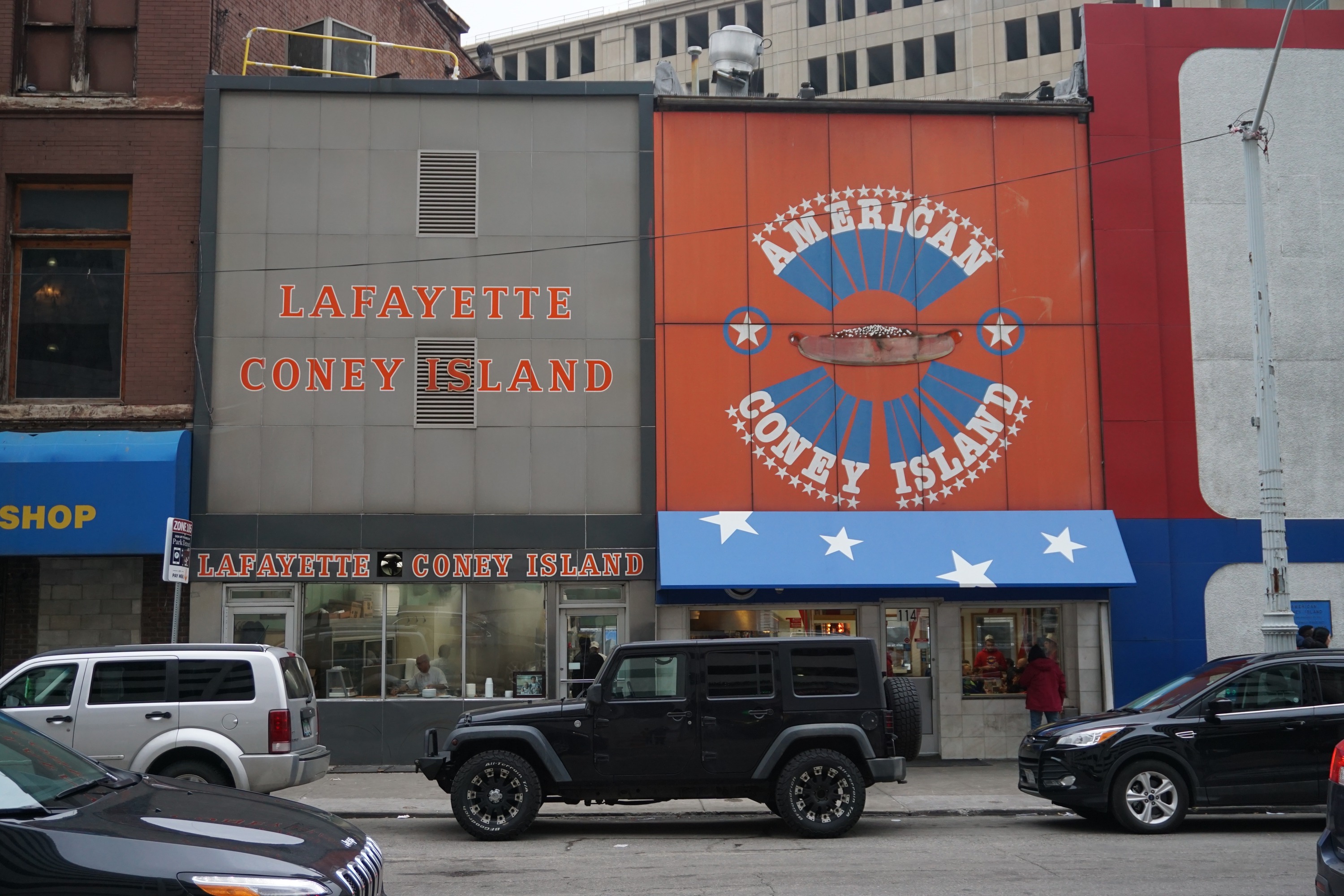
Two brothers opened the two coney counters Detroit argues about, next door to each other on West Lafayette Street. Gust Keros, a Greek immigrant, opened American Coney Island there in 1917. He brought his brother William to Detroit to help in 1924, and William opened Lafayette Coney Island when the space next door opened up. A Coney dog is a beef frankfurter in natural casing in a steamed bun, under beanless chili, diced white onions and yellow mustard. The chili is where the two places differ. American makes its own, and Lafayette's comes from a family recipe.
The Old English D is older than the Tigers' major league status. The National League's Detroit Wolverines wore one on the front of the jersey in an 1881 photo, and Detroit's Western League team had an "old English letter D" on its uniform in 1896. After decades of switching, the 1934 Tigers went back to the Old English style, though the D on the cap didn't match the D on the jersey until 2018.
Hockeytown came out of a marketing campaign. Bozell Worldwide's Detroit office created it in 1996 for the Red Wings' 70th anniversary, and the wordmark went over the Winged Wheel at center ice at Joe Louis Arena that season. The team took it off the ice in 2018, at Little Caesars Arena, and put it back for the 100th season.
The Fist belongs to an art museum. The Monument to Joe Louis was a gift from Sports Illustrated to the people of Detroit and the Detroit Institute of Arts on the museum's centennial. Robert Graham made it in bronze, a 24-foot arm with a fisted hand suspended from a 24-foot pyramidal frame at Jefferson and Woodward. It was dedicated on October 16, 1986. "Joe gave the people someone to cheer for during the [Great] Depression," Mayor Coleman A. Young said that day.
Wayne County built a mile of concrete on Woodward between Six Mile and Seven Mile in 1909, for $13,537. The state marker in Palmer Park calls it the first mile of concrete highway in the world, and road builders came from far and near to see how it stood up under traffic. The Woodward Dream Cruise began in 1995 as a fundraiser for a children's soccer field in Ferndale. Nelson House and a handful of volunteers planned one event for as many as 30,000 spectators. It drew 250,000.
The Michigan left came out of a fix that failed. Telegraph Road got directional crossovers 350 feet past the cross streets in 1960, and they didn't clear the gridlock. Joseph Hobrla, the State Highway Department's signal engineer, and Joseph Marlow, its district traffic engineer, moved the crossover to 660 feet on westbound Eight Mile Road at Livernois Avenue. To turn left, drivers go straight through the intersection and cross over in the median several hundred feet down the road. It has been built at more than 700 intersections.
James Vernor, a Detroit pharmacist, first served his ginger ale to the public in 1866, the year he opened his own pharmacy. He had left a tonic of vanilla and spices, with ginger added, in an oak barrel when he went to the Civil War in 1862. A family member says he didn't create the formula until after the war. The Boston cooler wasn't named for Boston Boulevard. It pairs vanilla ice cream with Vernors, and its name was an early 20th century term for any drink that mixed ice cream and soda. The Vernor's company copyrighted the name in 1967 for an ice cream bar.
Faygo started with frosting. Ben and Perry Feigenson, recent Russian immigrants trained as bakers, started bottling lager beer, mineral water and soda water in Detroit in 1907, and they began making soft drinks from their frosting flavors. The first were fruit punch, strawberry and grape, bottled on Benton Street and sold fresh from a horse-drawn wagon the day after they were made. Faygo became the brand name in 1921. The bottle works moved to Gratiot Avenue in 1935, and Faygo is still made there. The most popular flavor is Redpop, one of the brothers' earliest.
Photo: American and Lafayette, side by side, Wikimedia Commons, CC BY-SA 4.0