Sebastian S. Kresge gave up golf because he couldn't stand the lost balls. The same man gave his foundation $60,577,183 in his lifetime, and when he died in 1966, at 99, his personal estate was worth less than one-tenth of what he had given it. "I never spent more than 30 cents for lunch in my life," he once said.
The fortune started with $8,000 he saved in five years as a traveling tinware and hardware salesman. He and J.G. McCrory opened two five-and-ten-cent stores in 1897, one in Memphis and one in Detroit, and in 1899 Kresge traded his half of the Memphis store for full ownership of the Detroit one. It stood on Woodward Avenue between Grand River and State Street, in a four-story building at 189-91 Woodward that has since come down. It was 2,000 square feet, with 18 employees and 1,500 items, none over ten cents. The sign above the door read "Nothing over 10 cents."
His brother-in-law, Charles J. Wilson, became his partner, and for seven years they opened Kresge & Wilson stores in seven cities. When Kresge incorporated in 1912 as the S.S. Kresge Company, he owned 85 stores with sales of over $10 million, and stock went on sale to the public. The dime limit lasted until 1917. World War I inflation forced prices up to fifteen cents. That October 1 the company opened a nine-story store at Woodward and State, the corner Kresge had named Kresge Korner. The building still stands at 1201 Woodward.
Kresge was 57 when he set up the foundation, on June 11, 1924, for the company's 25th anniversary, with $1.3 million and a directive, "To promote the well-being of mankind." Its trustees met for the first time in 1925, and a $100 disbursement went to the Salvation Army of Detroit. A year later he added 500,000 common shares of S.S. Kresge Co. stock, valued at $22 million. In 1948 a $612,000 gift established the Kresge Eye Institute, which the foundation funded for 20 years until it became part of Wayne State University in 1968.
The discount stores were the plan of Harry B. Cunningham, the company's president. The first Kmart-branded store opened in San Fernando, California, in January 1962, and on March 1 the first Kmart built from the ground up opened in Garden City. In 1971 the value of the foundation's stocks rose from $377 million to $650 million in a single year, mostly on Kresge stock climbing with the spread of Kmart.
The S.S. Kresge Company became the Kmart Corporation in 1977.
The family protested. "I don't think it makes any sense to change from the name of a founder to a name that doesn't relate to an individual," said Stanley Kresge, the founder's oldest son and chairman of the foundation after his father's death. By 1987 Kmart had sold the last Kresge stores to the McCrory Corporation.
The foundation kept the name. In January 2013 it aimed some $150 million in Detroit grants and investments over five years at the Detroit Future City framework. In 2014 it gave $100 million to the grand bargain, the $300-plus million effort to meet the city's pension obligations and preserve the collection of the Detroit Institute of Arts. More than $58 million in grants went to the QLine streetcar between 2007 and 2022, and its endowment passed $4 billion in 2020.
Albert Kahn designed both of the company's Detroit headquarters. The first, an 18-story tower at Park and Adams overlooking Grand Circus Park, opened in 1914, and the company used about half its floors. On May 19, 1930, the company moved to Kahn's 250,000-square-foot Art Deco building at Temple Avenue and Second Boulevard on Cass Park. It left for Troy in 1972, and Wayne State University owns that building as The Block at Cass Park.
The old tower got a new name too. When Kresge moved out of Grand Circus Park it became the Kales Building. At the top, KRESGE was changed to KALES.
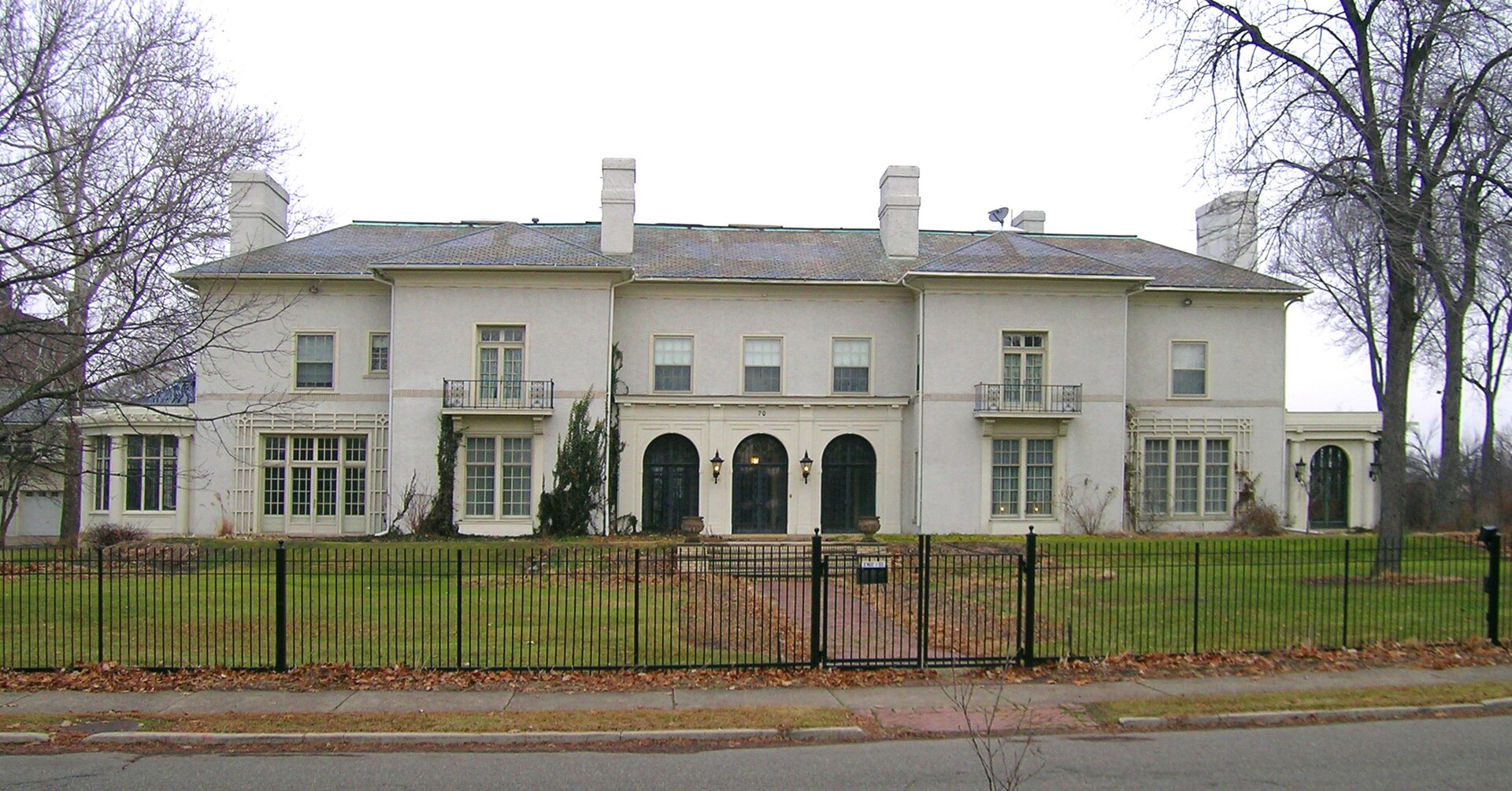
Photo: S S Kresge house on Boston, Andrew Jameson at English Wikipedia; via Wikimedia Commons, CC BY-SA 3.0