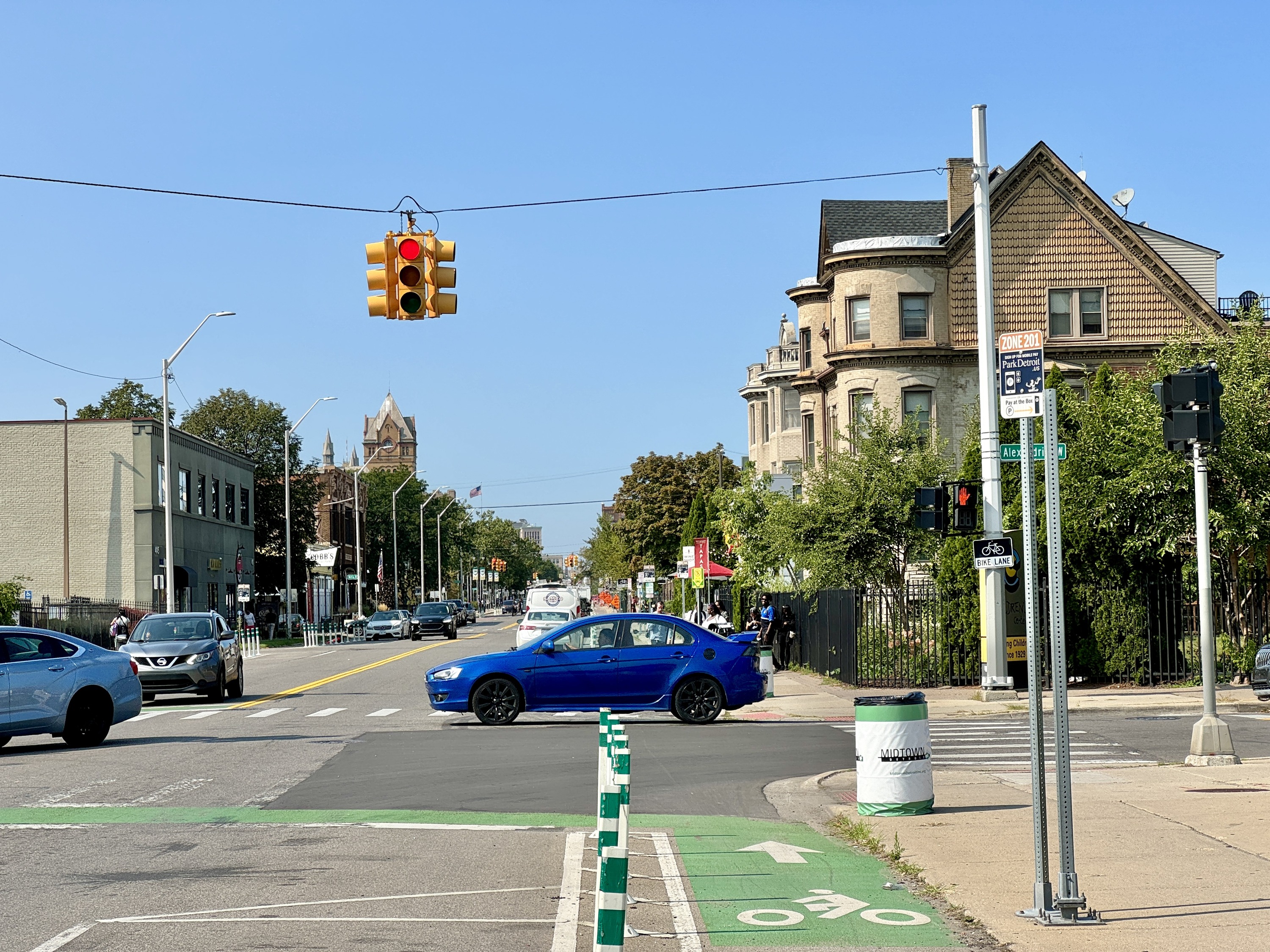
A condo goes up in Midtown, and a shooting happens in the Cass Corridor. That was the joke longtime Detroiters made about the two names for the blocks of Cass Avenue between Wayne State University and the Masonic Temple, the strip that gave the Cass Corridor art movement its name.
Sue Mosey, the former executive director of Midtown Detroit Inc., said in 2023 that the Midtown name was never intended to replace the Cass Corridor. "The Midtown name is a geography name and it's meant to represent a geography north of the downtown that's flanked by a bunch of freeways," she said. Her group grew out of the University Cultural Center Association, which has raised millions for the district since 2000.
Artists started renting cheap studio space in the Corridor in the 1960s, mostly in three complexes: the Convention Hall, Common Ground of the Arts and the Forsythe Building. Robert Sestok, who grew up in Birmingham, got his first Detroit studio in 1967 with Gordon Newton in the Old Convention Hall near Wayne State. The same building housed John Egner, a painting professor at Wayne State for many years, along with Michael Luchs, Brenda Goodman and Jim Chatelain. Luchs made "Rabbit" in 1974 from wire, carpet, cable and wood. Sestok and Paul Schwarz drew with the circular saw and the metal grinder.
Their main exhibition space was the Willis Gallery, on Willis, in the same building as Cobb's Corner, a hangout for artists. The gallery started as a co-op with Dan Moriarity as director. It drew the attention of Sam Wagstaff, curator of contemporary art at the Detroit Institute of Arts from 1968 to 1971.
By the end of the 1970s, most of the original artists had moved away.
The Detroit Institute of Arts hung "Kick Out the Jams: Detroit's Cass Corridor, 1963-1977" in 1980, a show of 22 artists organized by the curators Mary Jane Jacob and Jay Belloli. In the catalogue, Jacob dated the formative era of the Willis Gallery from 1971 to 1977. Al Loving, Brenda Goodman and Sestok were among the Corridor artists who moved to New York, for a while or for good.
Artists from the Renaud, an apartment building at Hancock and Second, drank at the Bronx Bar, at Second Avenue and Prentis, which opened in 1937. George Jordan started there as a bartender in 1942 and later bought the place. On one night in 1975, the painter Jim Chatelain said, "You draw with whatever you have," and pointed at the bartender-owner, who was mopping the floor like an abstract expressionist.
The Masonic Temple at 500 Temple Avenue, facing Cass Park, was dedicated on Thanksgiving Day 1926. George D. Mason & Co. drew the plans. Its tower is 210 feet high, the building holds 1,037 rooms, and it is the world's largest Masonic temple. In 2013 it was days away from being put up for sale over its 2010 to 2012 taxes. Jack White paid the $142,000 bill.
The Cass Corridor Neighborhood Development Corporation spent $16.7 million to renovate two apartment buildings at Cass and Martin Luther King, the Davenport and Cass Plaza, and reserved them for low-income people. "Affordable housing must be a part of the development of this area," Mosey said when ground was broken for the renovations.
Chuck Roy opened Cass Cafe at 4620 Cass Avenue in 1993, and art exhibitions changed constantly on its walls. When the artist Gilda Snowden died in 2014, her repast was held there. The cafe closed on July 17, 2022, after nearly 30 years. The Chalfonte Foundation, a Michigan nonprofit, bought the building and reopens it on November 6, 2026, with the kitchen, the bar and a radio studio for Village Radio, WEIE 99.7 LPFM, a low-power station based in Elk Rapids.
Photo: Cass Avenue in the Cultural Center, 2024, w_lemay via Wikimedia Commons, CC BY-SA 2.0