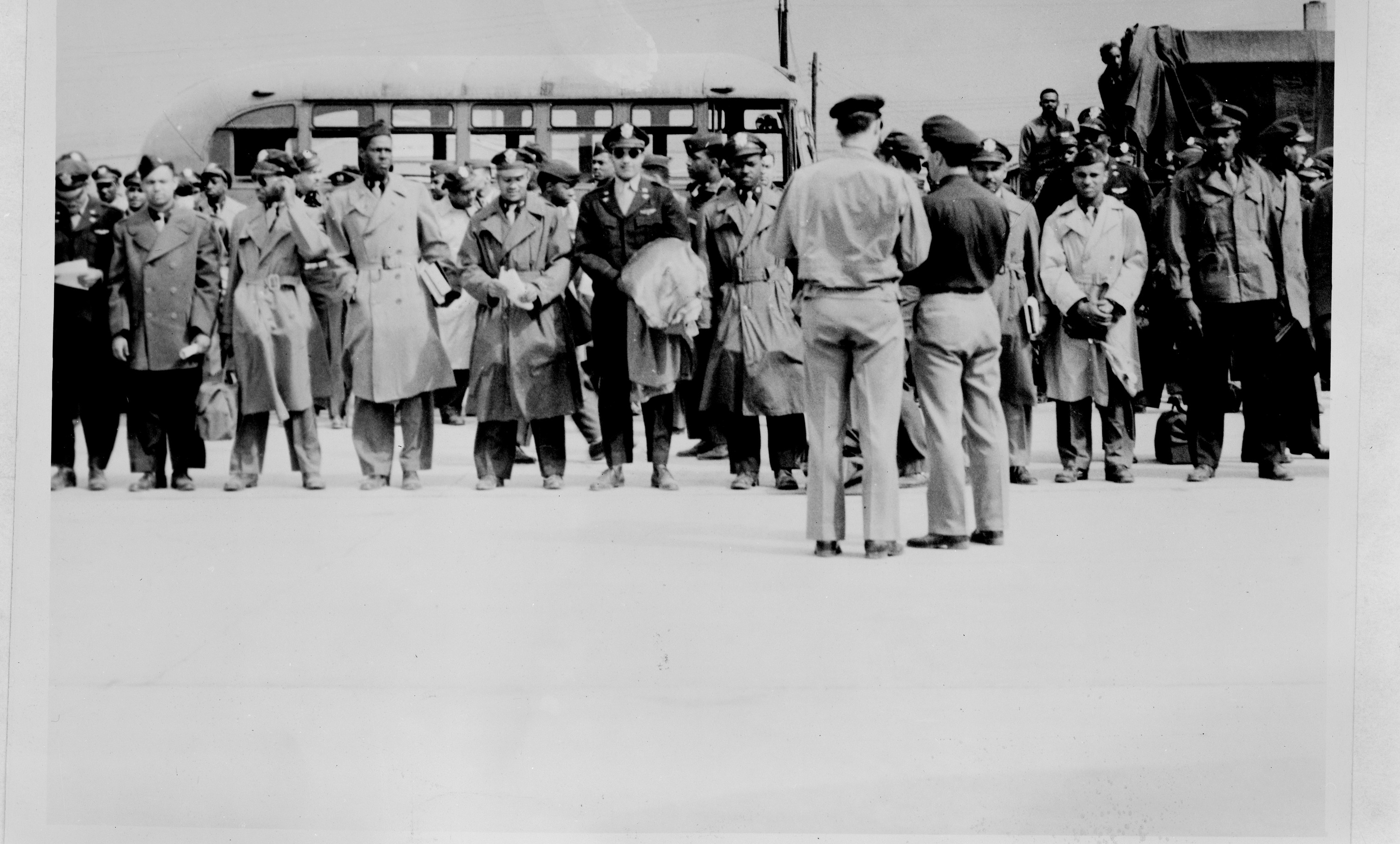
Coleman Young led Black officers into the whites-only officers' club at Freeman Field, near Seymour, Indiana, on April 5, 1945, and was arrested. Nineteen officers were put under arrest on the spot and 61 within two days. Then 101 refused to sign an order confirming the segregated clubs. Three faced court-martial. Roger Terry, the one convicted, was pardoned in 1995.
Young had gone into the Army Air Forces in World War II as a second lieutenant and trained as a bombardier and navigator with the 477th, the Tuskegee Airmen's bomber group. The 477th was activated at Selfridge Field outside Detroit on January 15, 1944. It flew B-25 Mitchell bombers and moved to Godman Field, Kentucky, and then to Freeman Field, Indiana. The war ended before it deployed.
Seven years later he appeared before the House Un-American Activities Committee at its Detroit hearing. Young, whose organizations included the National Negro Labor Council, repeatedly cited the Fifth Amendment and refused to say whether he was a Communist. "I am not here to fight in any un-American activities, because I consider the denial of the right to vote to large numbers of people all over the South un-American," he told the committee on February 28, 1952. The FBI had been watching him since the 1940s and kept at it into the 1980s.
He won a state Senate seat in 1964. On November 5, 1973, Coleman Young beat Police Commissioner John Nichols for mayor of Detroit by about 14,300 votes, roughly 51.6 percent, with both daily papers behind him. Nichols had led the September primary. The general election turned on STRESS, a police decoy unit accused of killing 22 people in two and a half years, and Young campaigned against it. In January 1974 he became Detroit's first Black mayor, and he promptly disbanded the STRESS unit.
Young was born in Tuscaloosa in 1918, and his family joined the Great Migration to Detroit in 1923. He graduated from Eastern High School in 1935, joined the UAW and worked for Ford.
His administration saw the completion of the Renaissance Center and the Detroit People Mover, and he promoted Joe Louis Arena. Detroit re-elected him in 1977, 1981, 1985 and 1989, and he served five terms, twenty years in all. The city lost about 500,000 residents over those years. Jimmy Carter called him "one of the greatest mayors our country has known." His last term ran to January 1994.
He died on November 29, 1997, at 79. Emphysema took him. That December he became the first person to lie in state at the Charles H. Wright Museum. The City-County Building was renamed the Coleman A. Young Municipal Building in 1999, and Detroit City Airport followed in 2003. In 2022 the Michigan Legislature voted to put his statue in the U.S. Capitol.