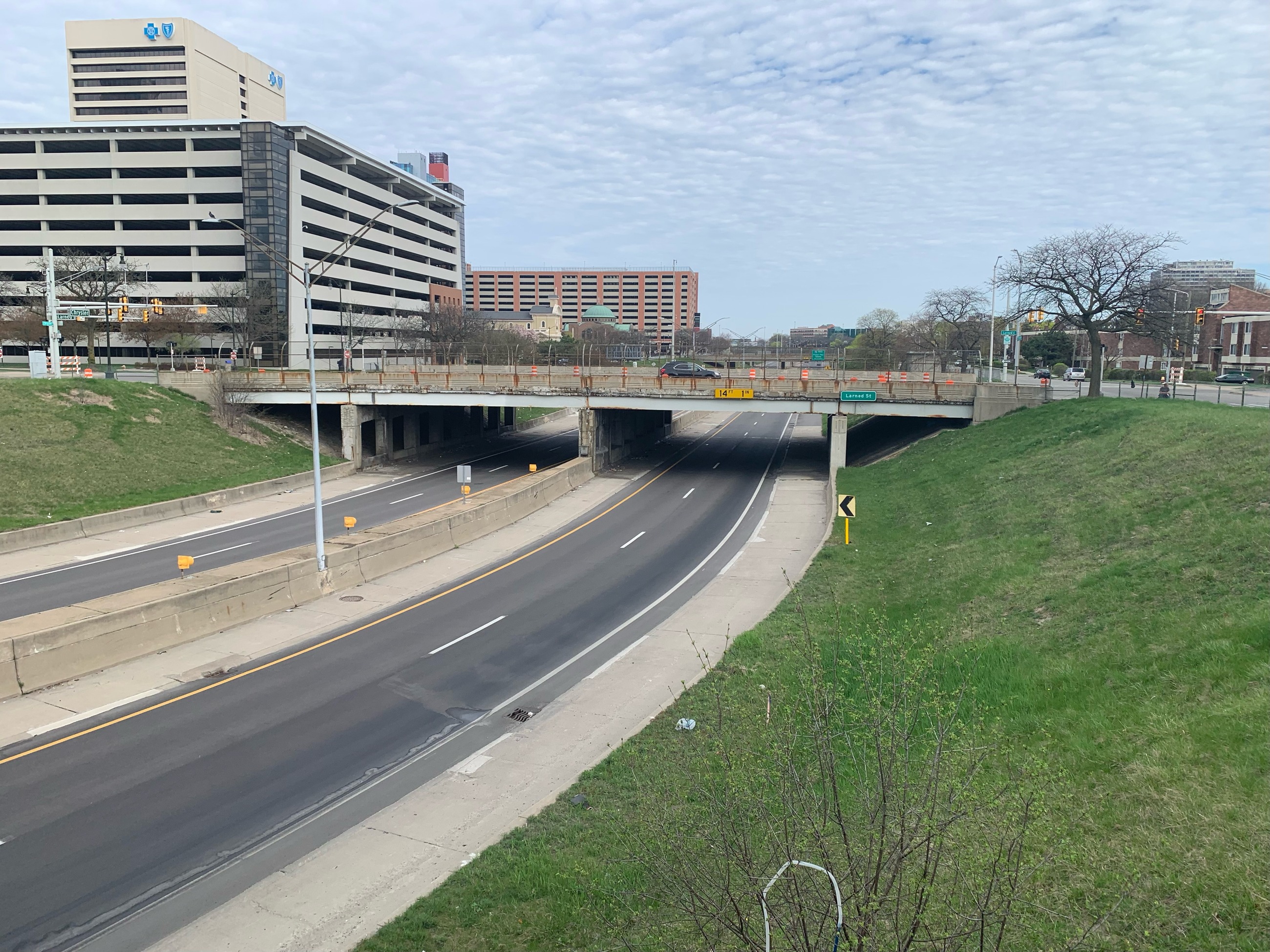
A city employee walked the streets of Black Bottom in the late summer of 1949 and photographed each address, one house after the next. The pictures were a first step in condemning those blocks, taken almost certainly before the people in them knew, and the ground they show lies under Interstate 375 and Lafayette Park. The state plans to start filling in that freeway trench in 2027.
Joe Von Battle took over a general store at 3530 Hastings in 1945 and started selling records from his own collection. He recorded John Lee Hooker, put out some 75 records by Rev. C. L. Franklin of New Bethel Baptist Church, and in 1957 was the first to record Franklin's 14-year-old daughter, Aretha, on the gospel song "Never Grow Old." His daughter, the writer and historian Marsha Battle Philpot, says he played the Franklin records out of a loudspeaker until church broke out on the street and the police came. "They got the word that there was going to be a freeway built and that freeway was going to replace everything on Hastings St., including all of the businesses," she said.
He moved the store to 12th Street.
Black Bottom sat on Detroit's near east side, bounded by Gratiot Avenue, Brush Street, the Detroit River and the Grand Trunk railroad tracks. Its name came from the rich marsh soils of the River Savoyard, buried as a sewer in 1827. Hastings Street ran north and south through it and had been a center of Eastern European Jewish settlement before World War I. Detroit's Black population grew from 41,000 to 120,000 in the 1920s, and restrictive covenants kept the newcomers out of most other parts of the city.
Paradise Valley, the overlapping area north of Gratiot, was the business district and entertainment center. More than 300 Black-owned businesses ran there, from drugstores to bowling alleys with bars. The Flame Show Bar, the Horseshoe Bar and Club Harlem booked Black artists for mixed crowds, and the Paradise Theater, opened in 1941 in the former Orchestra Hall, brought in Duke Ellington, Billie Holiday, Louis Armstrong and Dizzy Gillespie. Coleman Young, Detroit's first Black mayor, grew up here.
Condemnation began in 1946, and the National Housing Act of 1949 and the 1956 highway act gave the city the money to clear the area in earnest. Relocation help was minimal. Many residents got 30 days notice to vacate, and a number moved into the Brewster-Douglass and Jeffries Homes public housing projects. Black Bottom was gone by 1954, and Paradise Valley lasted a few years more.
Ground was broken for I-375 on January 30, 1959, at Hastings and Monroe, and Mayor Louis Miriani led the event. The freeway opened in 1964 and cost $50 million. Of Hastings Street only a few blocks north of Interstate 94 remain. Lafayette Park, much of it designed by Ludwig Mies van der Rohe, went up on the cleared land, and in the 1970 census it was about 75 percent white.
The U.S. Department of Transportation awarded MDOT $104.6 million in 2022 to replace the trench with a street-level boulevard. With the I-75 interchange and work tied to Eastern Market, the price reached an estimated $520 million. Opposition from members of the business community and from Wayne County Executive Warren Evans led MDOT to pause the project on August 11, 2025.
MDOT came back on November 13, 2025, at Eastern Market, with a shorter boulevard built in phases. The plan fills the trench from Jefferson to Gratiot and rebuilds the Gratiot bridge over the Dequindre Cut, an estimated $120 million without the interchange. Jason Garza, MDOT's deputy region engineer, put the interchange likely 10 years away. The Federal Highway Administration approved MDOT's traffic analysis in July 2026, and the fill is anticipated to start in summer 2027.
The first work is underground. By November 2025 crews were laying a new storm sewer along Schweizer Place down to the riverfront. In early May 2026 they started moving utilities on the Gratiot bridge over the Dequindre Cut, then stopped for Flower Day at Eastern Market, the Memorial Day holiday and the Detroit Grand Prix.
Photo: I-375 in 2023, TenPoundHammer via Wikimedia Commons, CC BY-SA 4.0