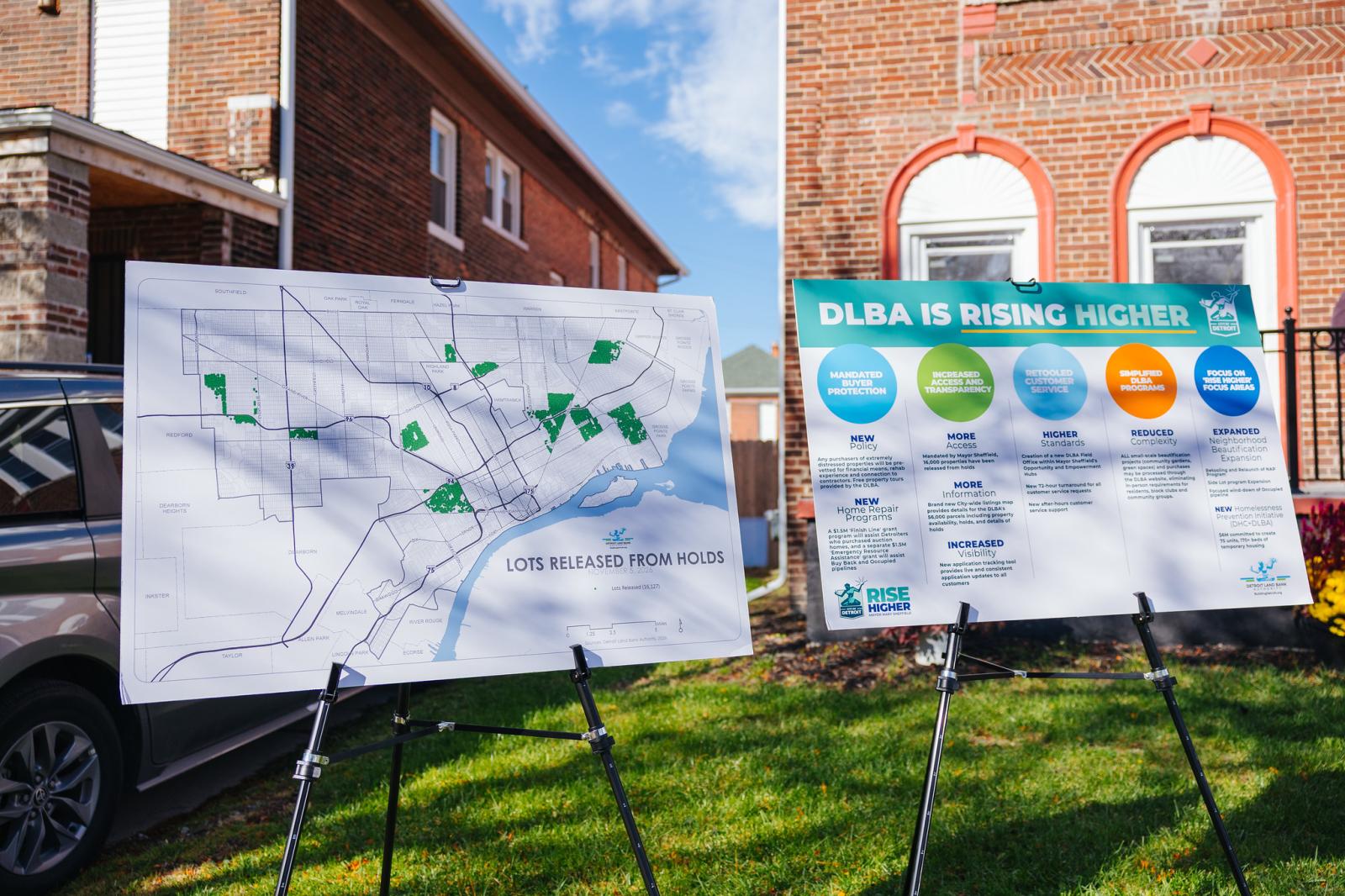
If you've had your eye on a Detroit Land Bank house or the empty lot next door and found it on hold, it's worth looking again.
Mayor Mary Sheffield and Detroit Land Bank Authority CEO Tammy Daniels announced a package of Land Bank reforms on Nov. 9. The city calls it the 5-point Rise Higher plan. The plan includes releasing holds on 16,000 Land Bank properties so they can be sold.
Those holds had kept properties off the market because they were being reserved for potential future development. The Land Bank has approximately 56,000 parcels, so the released holds reach more than a quarter of its inventory.
A new online map will show which parcels are available and why others remain on hold, and an application tracking tool will help buyers see where their requests stand.
Since it was restructured in 2014, the Land Bank has facilitated the sale and renovation of 15,000 vacant homes and sold 35,000 side lots, according to the city.
Help for buyers and renovators
For people who've already bought a Land Bank home, a new $1.5 million Finish Line grant program will help support repairs needed to meet the Land Bank's renovation requirements. A separate $1.5 million Emergency Resource Assistance program will assist occupants of Land Bank properties who complete the Occupied Buy Back program.
The announcement doesn't include grant application dates, individual award amounts or full eligibility requirements, so hold off on budgeting around the money.
Eyeing one of the most distressed houses? The Land Bank will offer free tours so prospective buyers can see the work needed before making a commitment. It'll also look more closely at buyers' finances and renovation experience.
Easier to reach, easier to use
The Land Bank is setting a 72-hour turnaround standard for customer service requests, expanding after-hours service and creating a field office to provide more access to its programs in neighborhoods. The field office's location and the expanded hours haven't been announced.
Residents, block clubs and community groups will be able to handle small-scale beautification projects and related property purchases through the Land Bank website, with no in-person requirement. That covers projects such as community gardens and neighborhood green spaces.
The Side Lot program is expanding too, making more land available for purchase by longtime Detroit homeowners.
Neighborhood changes
Its Nuisance Abatement Program will stop surveying neighborhoods for troubled properties and will instead review referrals from residents, City departments, registered community groups and City Council. Occupied homes won't be subject to the program under the Sheffield administration, and people found living in a referred property will be referred for housing assistance.
The Land Bank will also commit $6 million to rehabilitate 75 homes, creating more than 170 temporary housing beds through a partnership with the Homeless Action Network of Detroit. No opening schedule has been announced.
What comes next
Sheffield, who said she heard these frustrations regularly during her years on City Council, put the goal plainly in the city's release: "Detroit residents deserve a land bank that is transparent, accessible, and focused on neighborhood stability."
The administration plans several additional rounds of Land Bank improvements in the upcoming months.
If a property you wanted was on hold, the city's advice is to check its availability as the newly released properties become available for purchase. Current buyers who need help finishing renovations should watch for application details on the new grants. Listings and programs are on the Detroit Land Bank website, and the city's full explainer is here.