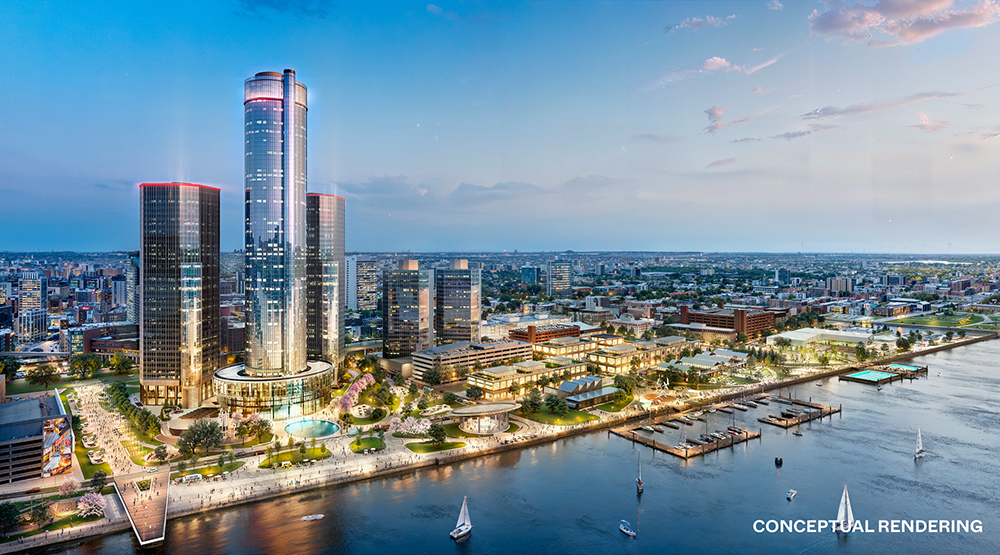
Every Tuesday at 6 p.m., on the 13th floor of the Coleman A. Young Municipal Center, Detroit gets its say on what happens to the Renaissance Center.
The meetings run the community benefits process for a $1.6 billion plan by Bedrock and General Motors to reconfigure the RenCen and rebuild the riverfront around it. Bedrock would cover about $1 billion, GM $250 million, and public financing the rest, including up to $75 million from the Downtown Development Authority.
Here is why the Tuesday nights carry weight: they are the public window before the votes that decide it all. Detroit City Council and the Michigan Strategic Fund both have to approve the project's brownfield plan by March 31, 2027, or the DDA money voids.
The part that stops Detroiters cold is the towers. Two of the five would come down, taken apart over about a year in what the developers call strategic deconstruction. Three would stay, reworked into one residential tower, one mixed-use building with a hotel, and one held for future office space. The path to that plan cleared when City Council rejected a resolution seeking a historic-designation study in a 2025 vote; the city argued the redevelopment was the only viable way to keep any of the complex standing.
What replaces the towers is big. The proposal covers more than 40 acres and calls for 934 mixed-income residential units, an 858-room hotel with an observation deck, 17 acres of civic space including parks and a marina, and hundreds of thousands of square feet of retail and modernized office space.
The stakes for residents are concrete. Roughly 4,600 people live in the impact area, and a nine-member Neighborhood Advisory Council will negotiate what the neighborhood gets in return, two members elected by residents and the rest appointed by City Council and the Planning and Development Department.
The first meeting ran nearly two and a half hours, and residents pushed back. "The rushed implementation of this is really our issue. What is the rush?" asked Eric Dueweke, a community development organizer who wants the impact area widened. Community advocate Beverly Kindle-Walker called the proposal "dumb" and told officials to "leave it like it is." Transit advocate Michael Cunningham had a simpler ask: "I want something for transit."
Demolition is targeted for summer 2027, after Detroit hosts the NCAA Final Four that April. The developers want approvals before the end of 2026 and hope to start the first phase in 2027.
Any impact-area resident who is at least 18 and free of conflicts with the developer and the city can be nominated to the council. The meetings continue every Tuesday at 6 p.m. through October 27 at the Erma Henderson Auditorium. A public engagement hub next to the RenCen at 521 Atwater opened August 19 and stays open for six months, taking feedback on what should rise east of the complex.