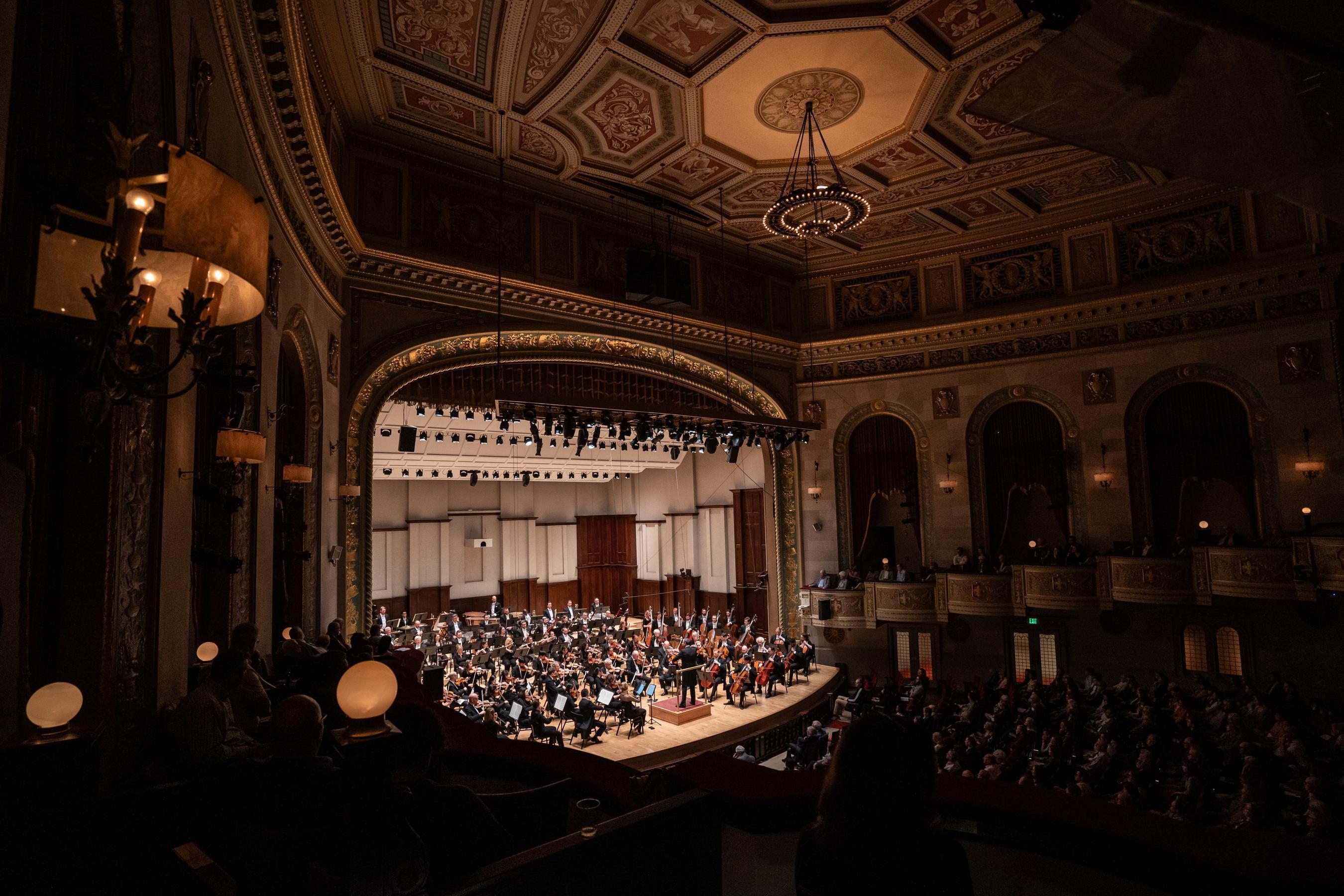
The Detroit Symphony Orchestra built its 2025-2026 season around music being written now. Per the orchestra's own season announcement, the calendar carries fifteen works by living composers, including a world premiere and a pair of DSO co-commissions, a deliberate push to set contemporary voices next to the standard repertoire.
The throughline is Michael Abels, named the DSO's composer-in-residence for the season. The orchestra describes him as a Pulitzer Prize winner best known for the opera Omar, which he co-composed with Rhiannon Giddens, and for his film scores for Jordan Peele's Get Out, Us and Nope. Detroit audiences get a spread of his work across the season, from the orchestral pieces Unbound in October and Global Warming and More Seasons in November to a world-premiere suite from Omar in February. His writing moves easily between concert hall and screen, which suits an orchestra trying to widen what a season can sound like.
That impulse is not new for the DSO. Its Classical Roots program, per the orchestra, dates to a 1978 inaugural concert at Detroit's Bethel A.M.E. Church under conductor Paul Freeman. The program was created to raise awareness of the contributions African American composers and musicians have made to classical music, and it has grown over the decades into a wider effort that includes composer residencies, commissions, fellowships, school visits and community events. The same seriousness about whose work gets played runs through the new-music programming on this season's schedule.
The orchestra makes its home at Orchestra Hall inside the Max M. and Marjorie S. Fisher Music Center. But the DSO's history reaches into other downtown rooms too. Music Hall, the performing-arts venue a few blocks away, was bought by industrialist Henry Reichhold in 1944 specifically to host Detroit Symphony concerts, including the nationally broadcast Ford Sunday Evening Hour, according to the venue. The two institutions share a longer story than most audiences have reason to know.
Music Hall itself is in the middle of a major change. The venue was renamed orsa Music Hall in early 2026 under a naming partnership with orsa credit union, and it is planning a new building alongside the historic one. Per the venue and reporting in The Detroit News, the expansion would add a new concert hall, a music academy, recording and dance studios and a rooftop restaurant, turning a single downtown landmark into a fuller arts campus, with construction and an opening targeted later in the decade. Cost estimates for the project have shifted as plans have grown.
The civic ambition shows up elsewhere in the DSO's work, from its neighborhood programming with community partners to Detroit Harmony, the orchestra's pledge to provide an instrument and instruction to any student in the city who wants to learn. New music by and for Detroit fits squarely inside that mission.
Season and ticket details are at dso.org. Information on Music Hall is at musichall.org.