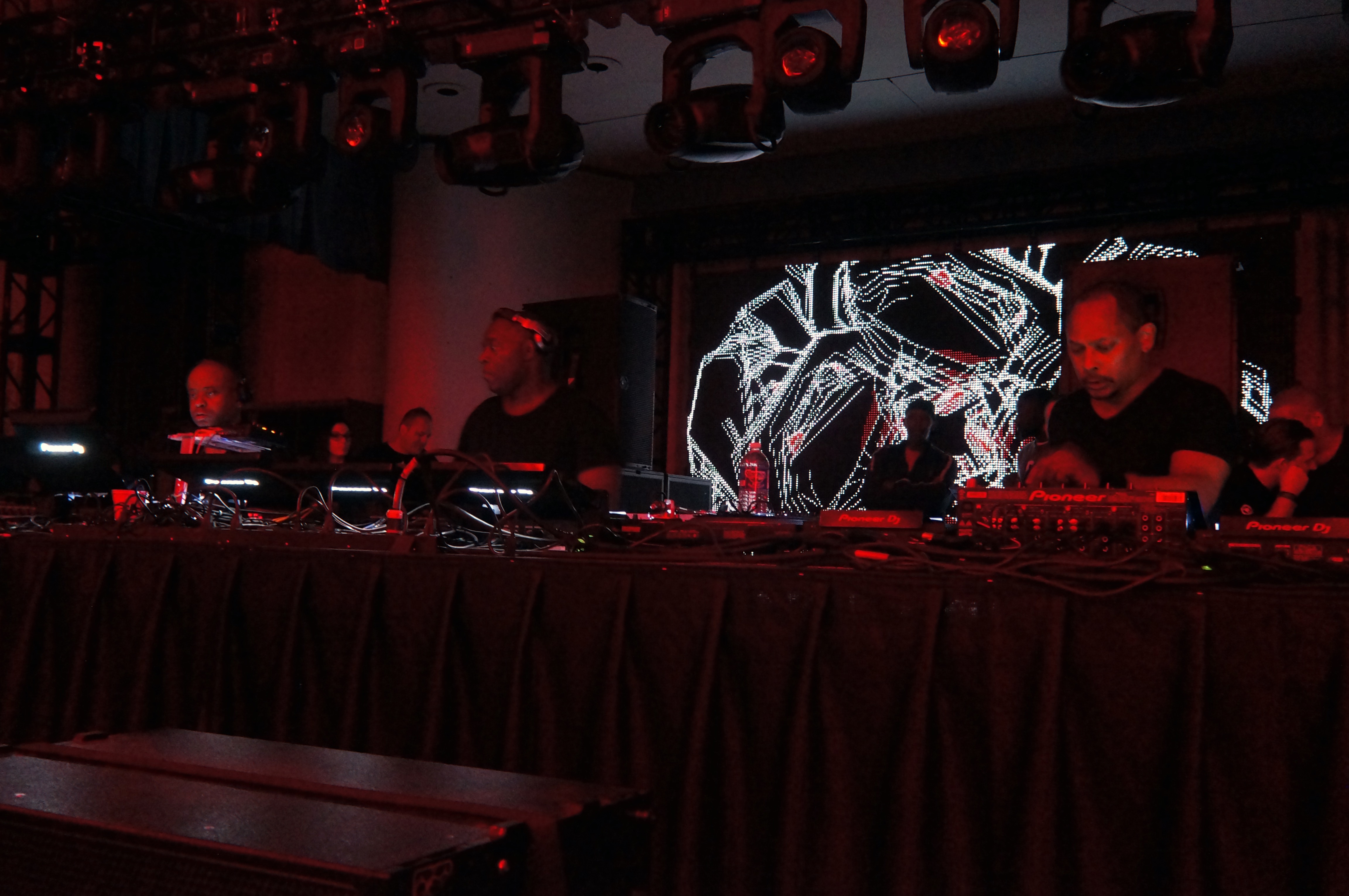
Chicago house and Detroit house get filed as one lineage. They are not. The two cities share a starting decade and a set of mutual influences, then they pull apart around 1990 in ways that still shape both scenes.
The Chicago side is well documented. Frankie Knuckles spinning at the Warehouse in the late 1970s, Ron Hardy at the Music Box, then a wave of producers including Larry Heard, Marshall Jefferson, and Steve "Silk" Hurley feeding the Trax Records and DJ International catalogs through the mid-1980s. Chicago house settled fast as a 4/4 dance music built on disco roots, drum-machine production, and a vocal tradition pulled straight from Black Chicago church singing. It exported to the UK first, then everywhere.
Detroit was in the room. Juan Atkins, Kevin Saunderson, and Derrick May, the trio known as the Belleville Three, drew on some of the same Italo and European synth records the Chicago producers were chasing, and folded them back into Detroit's own dance scene. Their music got named techno rather than a regional house brand, a choice the three made deliberately, but the two sounds shared dancefloors. The Music Institute, the after-hours club that ran at 1315 Broadway from May 1988 to a final party in November 1989, played Chicago house alongside the new Detroit material on the same nights. George Baker, Chez Damier, and Alton Miller ran it, and per Red Bull Music Academy's history of the room, its Saturday nights were modeled on the open, sensual DJing of Larry Levan and Frankie Knuckles. The scenes overlapped at the booth before they separated on record.
The split runs through tempo, texture, and the role of the vocal. The Detroit strand slowed down and went deeper. Inner City, Saunderson's project with vocalist Paris Grey, released "Big Fun" in August 1988 with a vocal Chicago could have written, but the track was already pop-leaning and built on a techno chassis rather than a straight disco loop. It topped the US dance chart and hit the UK top ten, and it pointed at where Detroit was headed. By the 1990s the city's deeper records were running on heavier basslines, longer arrangements, and sample beds drawn from Detroit's own soul, jazz, and funk catalog. The Chicago tradition leaned on disco; the Detroit one leaned on its hometown R&B archive.
Theo Parrish and Moodymann are the clearest cases. Parrish grew up in Chicago and carried that grounding to Detroit, but once his Sound Signature label was running in 1997 the records read as Detroit, not Chicago. Moodymann, Kenny Dixon Jr., had been in the city the whole time and launched his KDJ label in 1994; almost from the start its records used Detroit soul and disco samples in a way Chicago house did not. His "I Can't Kick This Feeling When It Hits" famously builds on Chic's "I Want Your Love." Both men landed early full-length statements at the turn of the decade, Parrish's "Parallel Dimensions" and Moodymann's "Forevernevermore" both arriving in 2000, and both sound slower and more melodic than the Chicago template.
Mike Huckaby is the third name. He came up in Detroit, worked the counter at the Roseville shop Record Time where his picks shaped a generation of local DJs, and ran his own labels, Deep Transportation and its tougher, dubbier sublabel SYNTH, both launched in 2002. His house carried a New York deep-house and dub-techno weight, looser and lower in BPM than Chicago's, Detroit by feel rather than by sample alone. Huckaby died in April 2020 at 54.
The records hold up the difference. On the Chicago side, "Move Your Body," "Promised Land," "Can You Feel It." On the Detroit side, "Big Fun," "Forevernevermore," "Parallel Dimensions." One catalog moves people through energy. The other moves them through depth.
The two cities still trade DJs and records. Movement books Chicago names every year and Chicago festivals book Detroit names back. The lineages stay intertwined without merging. Three decades on, they still make different records.