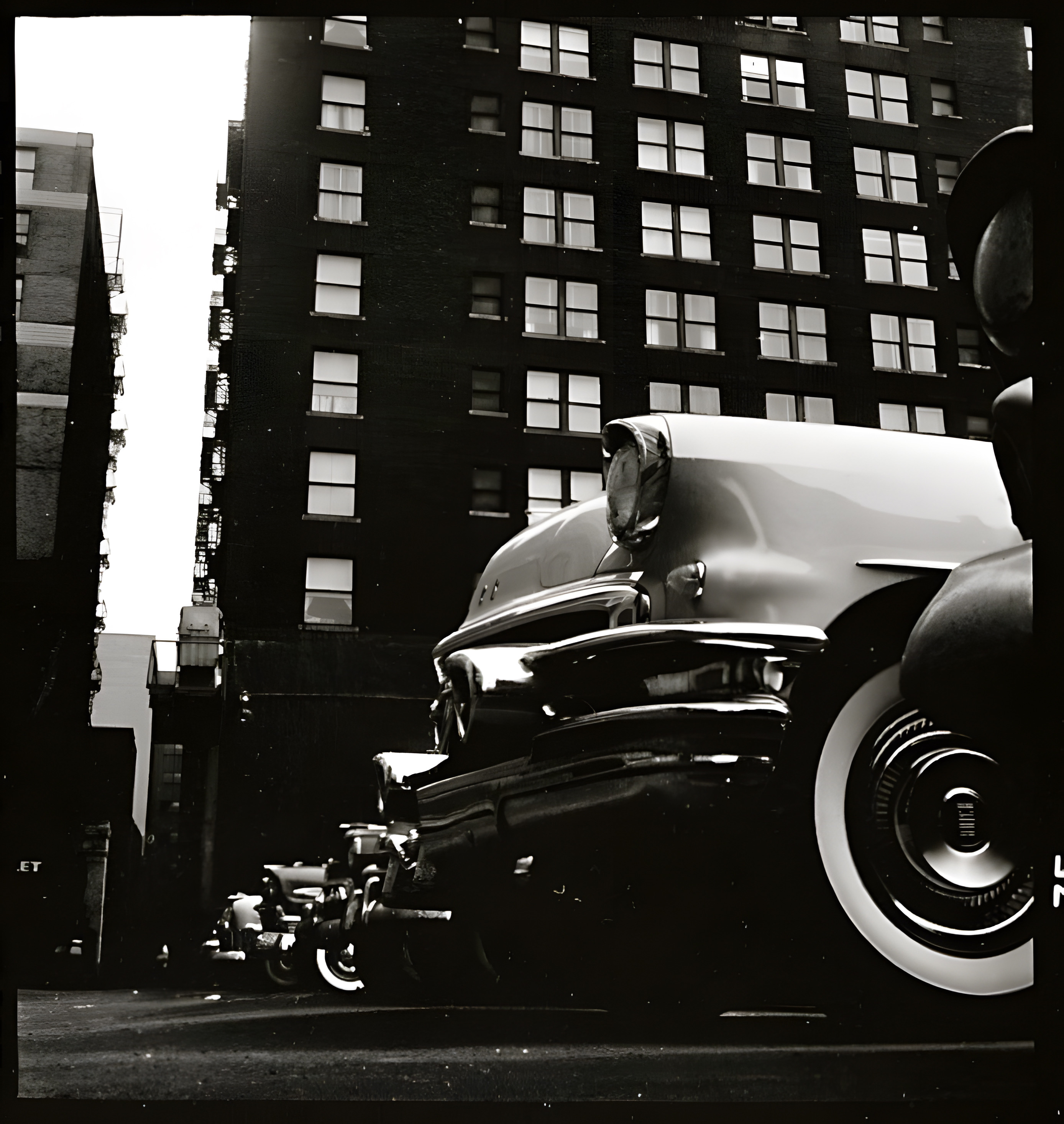
The Detroit Historical Museum is showing forty photographs by Norman Zadoorian, a mid-century Detroit photographer who spent his lunch breaks and evenings walking downtown with a twin-lens Rolleiflex. The exhibit, "The Searching Eye: Images of Mid-Century Detroit by Norman Zadoorian," runs through May 15, 2027, in the Detroit Artists Showcase gallery on the second floor. Some of his cameras sit alongside the prints.
Zadoorian worked as an industrial photographer for Detroit Edison, now DTE Energy. On his own time he turned the Rolleiflex on the city rather than the power infrastructure he was paid to document. The pictures span roughly the mid-1940s to the mid-1960s, black-and-white street scenes of pedestrians on downtown sidewalks, workers, and shoppers moving through a city near the peak of its industrial run. The Detroit Historical Society describes the work as a journey from the shadowed, noir-inflected images of the immediate postwar years to the brighter street scenes of the 1950s and after.
The show first appeared at the Library of Michigan in Lansing, which opened it in the Lake Erie Room in October 2024 and ran it through that December. The state library came to the archive through Norman's son, Michael Zadoorian, an award-winning novelist whose book "The Leisure Seeker" became a Sony Pictures Classics film starring Helen Mirren and Donald Sutherland. Michael wrote the exhibit text, including the short essays that accompany the photographs.
The Lansing run was organized into four themes: Night and the City, Detroit as Muse, City of Work, and A Life Behind the Camera. The forty prints at the Detroit Historical Museum are grouped into three sections, Night and the City, Detroit as Muse, and City of Work. A 1950 photograph titled "Ladies in the Snow" and a 1956 image titled "Chrome and Brick" are among the pictures on display.
Zadoorian was not a photojournalist or a gallery artist. He was a company photographer with a personal camera and a long habit of looking at the city on his own time. What accumulated reads now as street-level evidence of mid-century Detroit. Not the plants, not the promotional skyline. The sidewalk in 1950.
Detroit Historical Museum, 5401 Woodward Ave. Hours are Wednesday through Saturday 10 a.m. to 5 p.m. and Sunday 1 p.m. to 5 p.m.