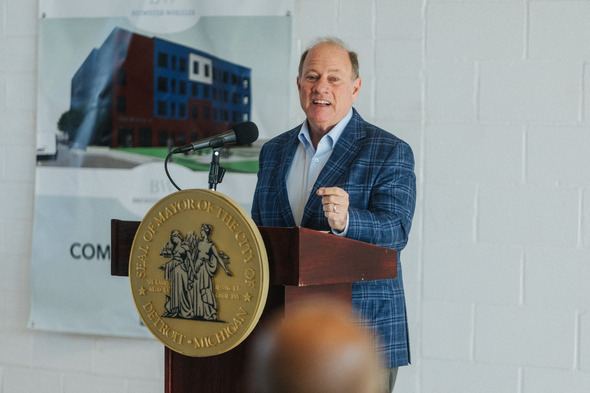
The City of Detroit broke ground on November 14 on an $80 million development that will bring 211 affordable apartments to long-vacant land next to the historic Brewster Wheeler Recreation Center in Brush Park.
According to the city, the project spans four buildings. Three of them, named Brewster I, II, and III, will hold 53 apartments each, a mix of one-bedroom and two-bedroom units. Rents are tied to household incomes ranging from 30 to 80 percent of the area median income, with one-bedrooms starting at $368 a month and two-bedrooms at $438.
The fourth building, called the Sanctuary at Brewster, holds 52 one-bedroom units of permanent supportive housing for residents leaving chronic homelessness. Every Sanctuary unit carries a project-based voucher, so residents pay no more than 30 percent of their income toward rent. The Detroit Housing Commission is providing those vouchers, and the city's coordinated assessment system will refer residents, with priority for households that have experienced long-term homelessness.
MHT Housing, Inc. and Kirsten's Touch, Inc. are co-developing the project. Kirsten's Touch is led by Bishop Charles H. Ellis III. Financing partners listed by the city include the Michigan State Housing Development Authority, the City of Detroit, Cinnaire, Fifth Third Bank, Comerica Bank, the Community Preservation Corporation, the Federal Home Loan Bank of Indianapolis, and Lake Trust Credit Union. MSHDA awarded a 9 percent Low-Income Housing Tax Credit toward the work.
On-site services at the Sanctuary will run more than 60 hours a week at no cost to residents, with Neighborhood Legal Services Michigan and the Detroit Wayne Integrated Health Network working alongside Kirsten's Touch. The support covers five areas: education, physical and mental health, workforce development, life skills, and legal assistance.
The land carries a long history. In 1935, First Lady Eleanor Roosevelt took part in the dedication of the Brewster Project, the first federally funded public housing built for Black residents in the United States, according to Michigan Advance. The complex later combined with the Frederick Douglass Apartments and at its peak housed thousands of residents, among them Diana Ross, Mary Wilson, Florence Ballard, Smokey Robinson, Loni Love, and Etterlene DeBarge in their early years. The adjacent recreation center is where Joe Louis trained. Demolition cleared the towers between 2003 and 2014, and the site sat largely empty afterward.
The recreation center is being restored alongside the new housing, with KRONK Gym set to return. The city is targeting 2026 for the recreation center and 2027 for the four apartment buildings.
"Today is about rebuilding a neighborhood and about rebuilding lives," Mayor Mike Duggan said in the city's announcement. Julie Schneider, director of the city's Housing and Revitalization Department, said Detroit's affordable housing strategy is rooted in ensuring that everyone, especially neighbors experiencing homelessness, has a safe place to call home.