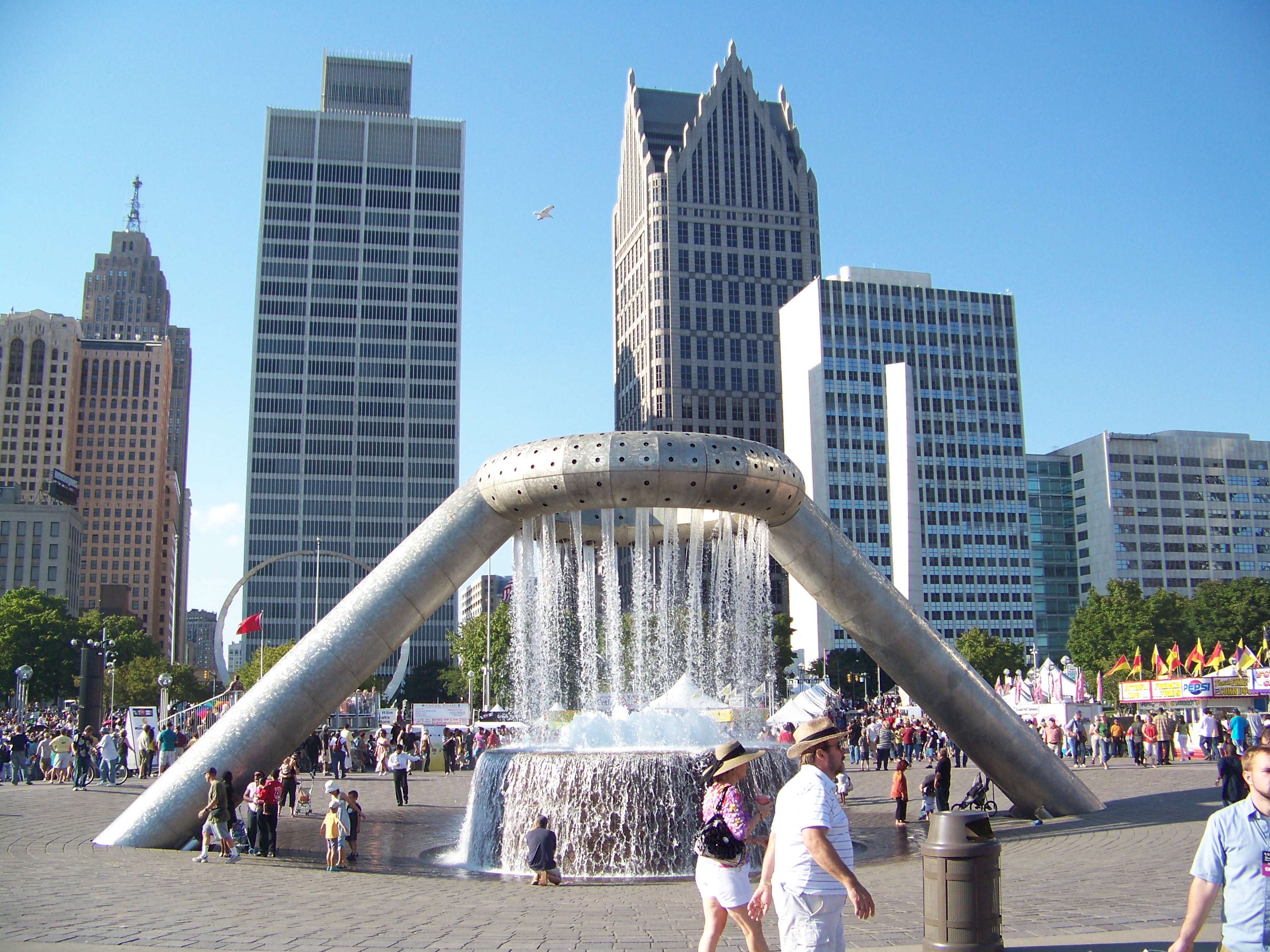
Hart Plaza opened on the Detroit River in 1975 and was dedicated the following year to Philip A. Hart, the Michigan senator. The 14-acre civic square was built by the Detroit firm Smith, Hinchman and Grylls in consultation with the sculptor Isamu Noguchi, who designed its two signature pieces: a 120-foot stainless steel Pylon at the entrance and, at the center, the doughnut-shaped Horace E. Dodge and Son Memorial Fountain. A sunken amphitheater sits in the slope toward the water. The city puts the plaza's capacity at roughly 40,000.
For a generation it was Detroit's default stage for big free public gatherings. The Detroit Jazz Festival, the African World Festival, and a rotation of summer concerts all ran here. In 2000, the city added one more.
The first Detroit Electronic Music Festival was free, ran three days over Memorial Day weekend, and put more people on the plaza than anyone downtown had planned for. Carol Marvin's Pop Culture Media produced it, with the Detroit techno figure Carl Craig as creative director and a lineup that ran from the city's founders to international acts. Contemporaneous coverage put the weekend crowd at more than a million, a figure that has been widely questioned since and is best treated as a rough, generous estimate rather than a count. What was clear at the time: the plaza had not held a crowd like that in years.
A version of the festival has returned to Hart Plaza nearly every Memorial Day weekend since, through a run of name and management changes. It was DEMF from 2000 to 2002, Movement in 2003 and 2004, and Fuse-In in 2005, the year it first charged admission. In 2006 the Detroit production company Paxahau took over and brought back the name Movement, which has stuck. Paxahau still runs it.
The plaza's fit with the music is part architecture, part geography. The amphitheater Noguchi helped shape gives the festival a below-grade bowl, and the layout lets a single ticket holder move between stages in minutes. Movement's own stage map has held at six in recent years: the Movement Stage in the amphitheater, the Stargate Stage near the entrance, the below-plaza Underground Stage, the riverside Pyramid Stage, a Detroit Stage given over to local artists, and the Waterfront Stage in the trees. The river and the Windsor skyline sit behind all of it.
Hart Plaza sees less programming than it did at its peak. The city has steered some events to the redeveloped riverfront to the east, the Aretha Franklin Amphitheatre absorbed much of the ticketed concert load, and downtown foot traffic has shifted with two decades of construction. Movement remains the largest single event on the plaza in most years.
The plaza is owned and run by the City of Detroit. Maintenance has been a recurring civic problem, and the Dodge Fountain in particular sat dark for stretches. The city began a restoration in October 2023, funded largely by federal American Rescue Plan money, that covered the fountain's panels, jets, lighting, and plumbing along with plaza waterproofing and pavement, the first stage of a roughly $9 million renovation. "Restoring the iconic fountain and revitalizing this historic space is not just about bricks and mortar," LaJuan Counts, who leads the city's Construction and Demolition Department, said in announcing the work. "It's about preserving our heritage." Later phases, including grand-staircase repairs and accessibility upgrades, have followed.
The festival is the yearly test of whether the plaza still works as a gathering place. By most accounts, it still does.
Hart Plaza, 1 Hart Plaza, Detroit.