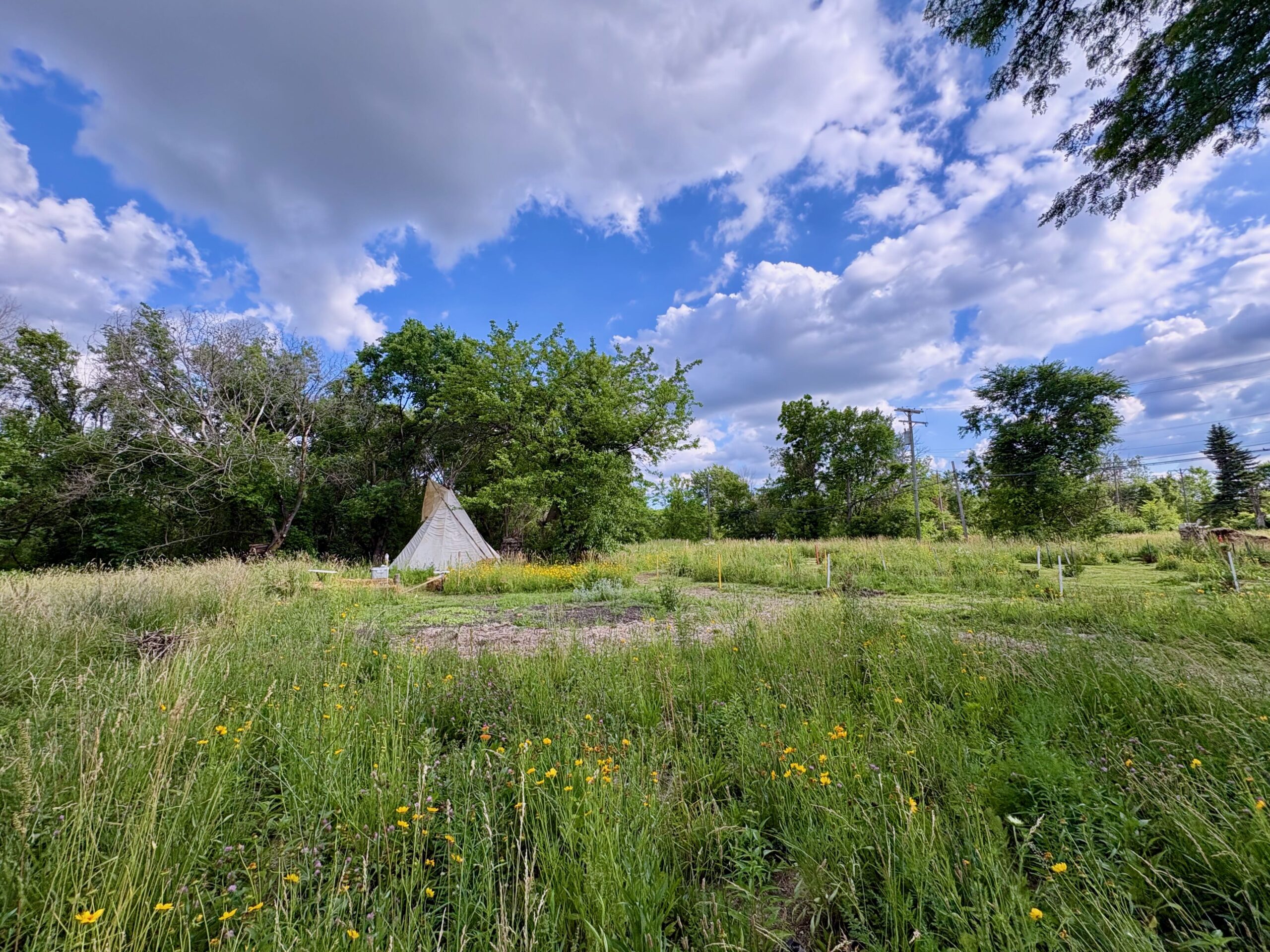
On five vacant lots along the historic upper banks of the Bloody Run, Detroit has a new place with an old purpose. It's called Noojimo'waning, Anishinaabemowin for "The Place of Healing."
The site is stewarded by Hadassah GreenSky Meshekey, a Traverse Bay Bands Odawa, Fond Du Lac Ojibwe, and Bodewadmi artist, musician, cultural worker, and land steward. She is turtle and bear clan. She is also a 2022 Kresge Arts Fellow.
Noojimo'waning was established as an expansion of the mission of Arboretum Detroit, the Poletown nonprofit behind the site. The work is a land back project, which the organization defines as "the return of Indigenous land taken through genocide, land theft and manipulative tax laws to Indigenous stewardship."
The land, made up of five city lots, sits alongside the historic upper banks of the Bloody Run. Today it holds a native meadow restoration with walking paths around a circle of trees. Those are giant sequoias in a 66-foot diameter circle, and white cedars in a 33-foot diameter circle. A circular garden has grown corn, beans, tobacco, and ground cherries. The project also raised funds for a 22-foot tipi and held many community gatherings, workshops, and work days.
The name isn't decoration. Healing is the point here, worked into the soil one season at a time, on ground that carries a hard history.
The return fits a wider shift in how the city handles vacant land. Detroit has begun clearing the way for Indigenous stewardship: the Detroit Land Bank Authority now offers a 50% discount on its auction properties to "eligible members of any federally recognized American Indian Tribe or Alaska Native Entity."
For a neighborhood that has watched block after block go empty, Noojimo'waning answers the vacant lot with corn and cedar and a tipi, tended now by Anishinaabe hands. It's a small five-lot footprint, and a long way of thinking about what a Detroit lot can hold.