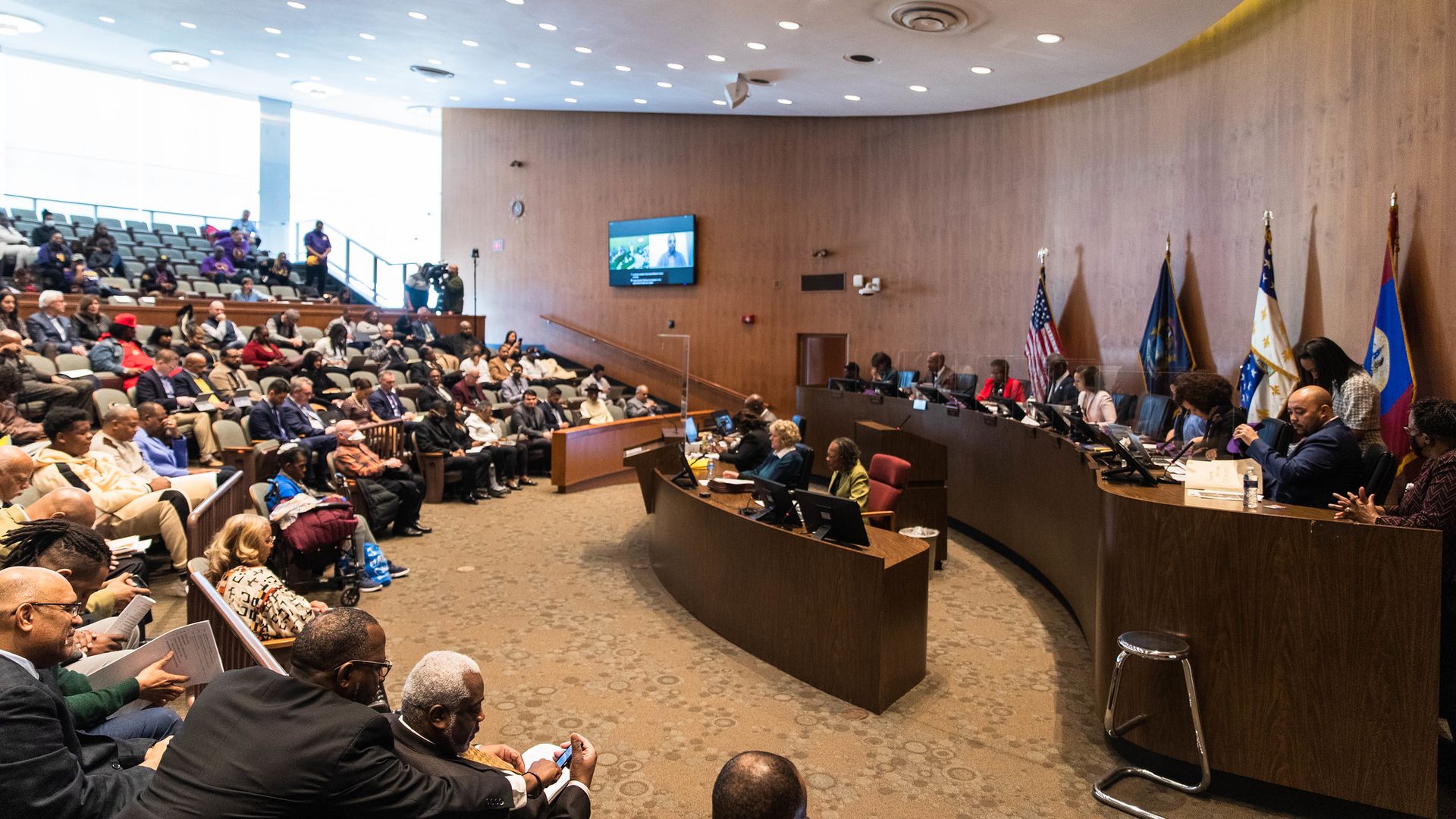
Detroit City Council voted unanimously on Tuesday, September 8 to have its Legislative Policy Division research how other Michigan cities have diversified their energy sources and improved their energy infrastructure. The request came in a memo from District 6 Council Member Gabriela Santiago-Romero, who pointed to Wyandotte and Ann Arbor as models. No deadline for the report was set at the session.
The vote came five days after a tornado crossed the lower east side. The National Weather Service rated the tornado EF-2, with an estimated peak wind of 115 mph, on the ground from 4:14 to 4:18 p.m. on Thursday, September 3, along a path 3.5 miles long and up to half a mile wide that started northeast of Comerica Park and crossed onto Belle Isle. The survey counted one injury and no deaths. It was the first tornado to touch down inside Detroit since July 2, 1997.
Four minutes did a lot of damage. Industrial buildings along Bellevue and Beaufait streets lost roofs and walls, and vacant buildings collapsed on St. Paul Street near Concord. By the time council met, the city's count stood at 115 locations touched, including 55 businesses, 24 single-family homes and about 20 multi-family buildings, with 254 trees cleared from more than 60 blocked streets by Sunday. Mayor Mary Sheffield signed an executive order on Friday, September 4 declaring a local state of emergency for the area bounded by Sylvester Street, East Jefferson, Chene and McClellan, plus Belle Isle, and said the devastation she saw was unlike anything she had seen before.
The power was the part residents felt longest. Nearly 30,000 Detroit customers lost power at the start, part of more than 300,000 DTE outages across the region that evening, and the utility says it restored more than 90 percent of its Detroit customers within 48 hours. Council President Pro Tem Coleman Young II said residents had gone two to three days without power and raised wind, solar and geothermal as options worth studying. District 2 Council Member Angela Whitfield-Calloway said residents want options and do not want to be locked into DTE. Santiago-Romero put it more bluntly from the dais: "Quite frankly, I feel like we're being robbed."
The administration is not fighting the idea. Chief of Staff David Bowser told the council the Office of Sustainability is already evaluating best practices and that the administration supports studying what other cities have done. At the same session, council unanimously extended the mayor's emergency declaration.
DTE said it has powered Detroit for more than 125 years, invested more than $1 billion in the city's grid over five years, trimmed trees along more than 350 miles of lines, upgraded 220 miles of infrastructure, replaced 2,270 poles and cut outage duration 91 percent between 2023 and 2025. The money behind that record is part of the argument. State regulators approved a $242 million DTE electric rate increase in February, and the utility filed in April for $474 million more.
What happens next is a report, not a switch. The Legislative Policy Division will write up what a community-run or diversified system has looked like elsewhere in Michigan, DTE representatives are expected at future council meetings, and the city is checking generator compliance at senior buildings. Strait will read the report when it lands.