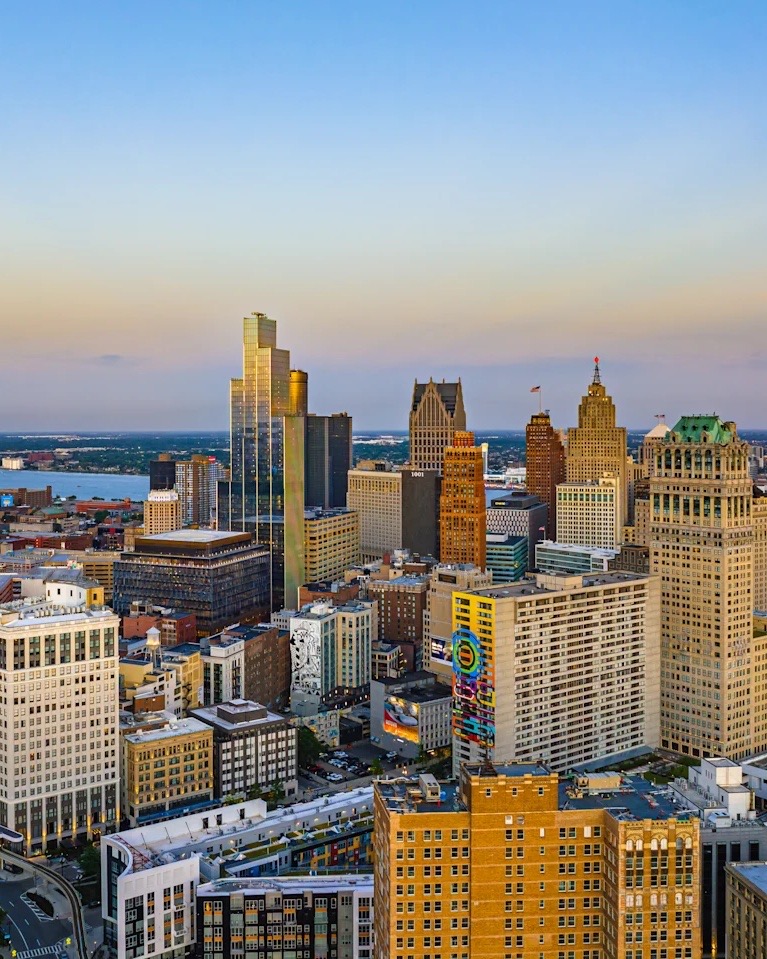
For years, Detroit's downtown recovery showed up mostly in real estate databases and construction filings. Now it is showing up in global research, and the finding is blunt. Detroit has the stickiest downtown in America.
That conclusion comes from Gensler's City Pulse 2026, the design firm's largest study of urban experience since the pandemic. Researchers surveyed roughly 35,000 residents across 75 cities in 30 countries between July 8 and November 4, 2025, covering 133 central business districts in all. The study's core measure pairs how often people visit a downtown with how long they stay once they get there. Gensler found that dwell time, not visit frequency, is the strongest predictor of whether residents feel their downtown delivers a great experience. Among the 34 American cities in the study, Detroit ranked first.
The numbers behind that ranking are specific. Detroit topped the U.S. cities for residents who say their downtown experience improved over the past year, at nearly 64 percent. It also ranked first in the country for walkability, with nearly 87 percent of residents calling downtown enjoyable to walk around in. And it led on discretionary visits, with 31 percent of residents saying they go downtown because they enjoy it rather than because they have to, against a national average of 16 percent.
Sofia Song, global leader of cities research at Gensler's Research Institute, framed the broader problem the study set out to measure. "People aren't staying away because they dislike their downtowns," she said. "They're staying away because the pull isn't strong enough, the friction is too high, or both."
Antoine Bryant, who runs Gensler's Detroit office and previously served as the city's director of planning and development, pointed to how tightly the downtown core is packed. Detroit places four professional sports teams within a half-mile of each other, with a shared arena for the Pistons and Red Wings and nearby stadiums for the Lions and Tigers. Little Caesars Arena, by Gensler's account, runs about 325 days a year and is the second most booked arena in the country. That density of scheduled events gives people a steady reason to be downtown across the full calendar.
Gensler also tied the turnaround to the public realm. The city added lighting on major corridors and side streets, leaned on Project Green Light Detroit, and invested in sidewalks and greenery. The report notes that residents find downtown safe without feeling overpoliced, with fewer than one in six Detroiters counting as reluctant visitors, the lowest rate in the study.
The next major draw is already taking shape. Cosm Detroit, an immersive venue rising in Bedrock's Development at Cadillac Square near Campus Martius, wraps viewers in a planetarium-style LED dome with a 180-degree field of view built to feel like sitting inside a live stadium. It is set to open downtown this fall.
For a city that has spent years making the case for its own future, a No. 1 ranking built on how often people come back is the kind of outside validation that does not need much translation.