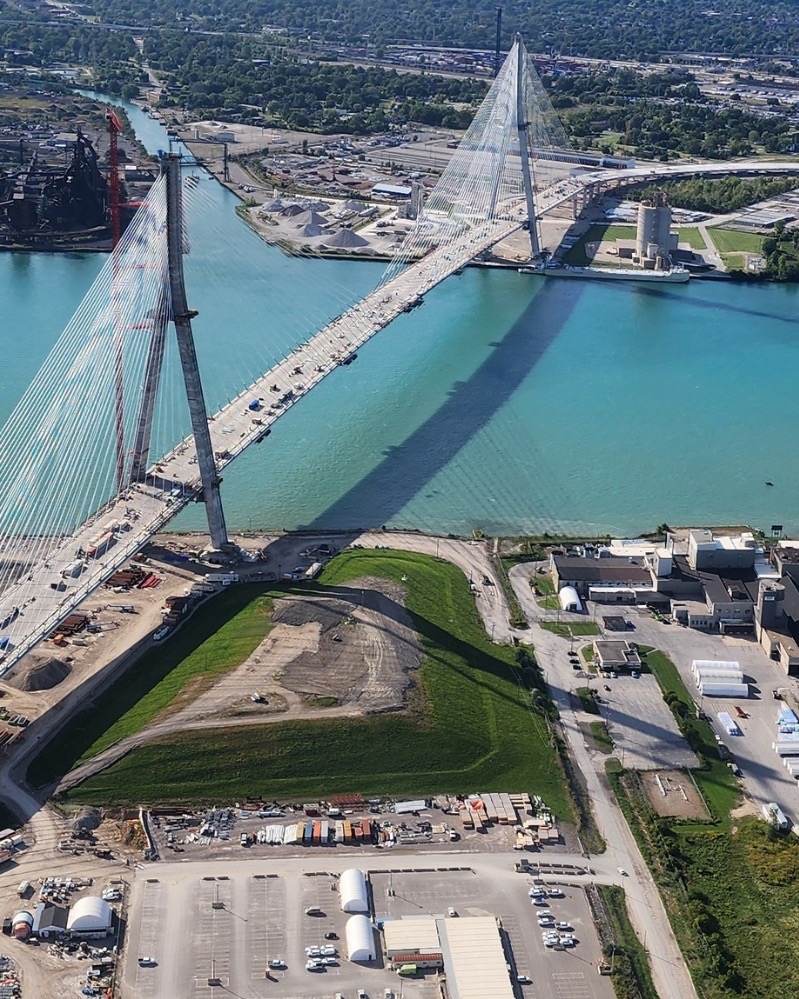
Detroit's new bridge to Canada is ready to open. The Gordie Howe International Bridge, the region's first new crossing of the Detroit River in nearly a century, is scheduled for a ribbon cutting on Friday, June 12. The span is set to open to traffic the following Monday, June 15.
The project has been long in the making. Bridging North America, the consortium delivering the bridge for the Windsor-Detroit Bridge Authority, broke ground in Southwest Detroit in July 2018 under a fixed-price contract valued at CA$5.7 billion. The Windsor-Detroit Bridge Authority is a Canadian Crown corporation, and Canada funded the construction.
The bridge runs about 2.5 kilometers, or roughly 1.5 miles, end to end. Its main span measures 853 meters, the longest cable-stayed main span on the continent. Two A-shaped towers, each 220 meters tall, carry the cables. They were designed to resemble hockey sticks at the moment of a slapshot, a structural tribute to Gordie Howe, the Detroit Red Wings Hall of Famer the bridge is named for.
What sets this opening apart is the multi-use path running alongside the road deck. For the first time, people will be able to walk or bike across the Detroit River as a regular, legal crossing rather than a one-off event. The path connects to the Trans Canada Trail and to local trails on both banks. The Ambassador Bridge, which has carried traffic between Detroit and Windsor since 1929, has never allowed pedestrians or cyclists. The Gordie Howe path, separated from vehicles by a barrier, changes that.
The crossing links Interstate 75 in Michigan to Highway 401 in Ontario, with full ports of entry and customs facilities on both ends. The road deck carries six lanes, three bound for each country.
Toll rates were set below the Ambassador Bridge for both passenger vehicles and commercial trucks. A passenger car pays US$5.75, dropping to US$4.35 for electronic-pass holders in the Breakaway program. Commercial trucks in that program pay US$6.90 per axle, against the roughly US$15 per axle that A-Pass and E-ZPass holders pay at the Ambassador. For a five-axle semi, the difference works out to more than US$40 a trip across one of the busiest trade corridors in North America.
For Southwest Detroit, which hosts the U.S. port of entry, the work has meant years of construction coordination, including noise walls built along the project to reduce the impact on nearby residents. As of Friday, that era ends, and the city has a second way to reach Canada.