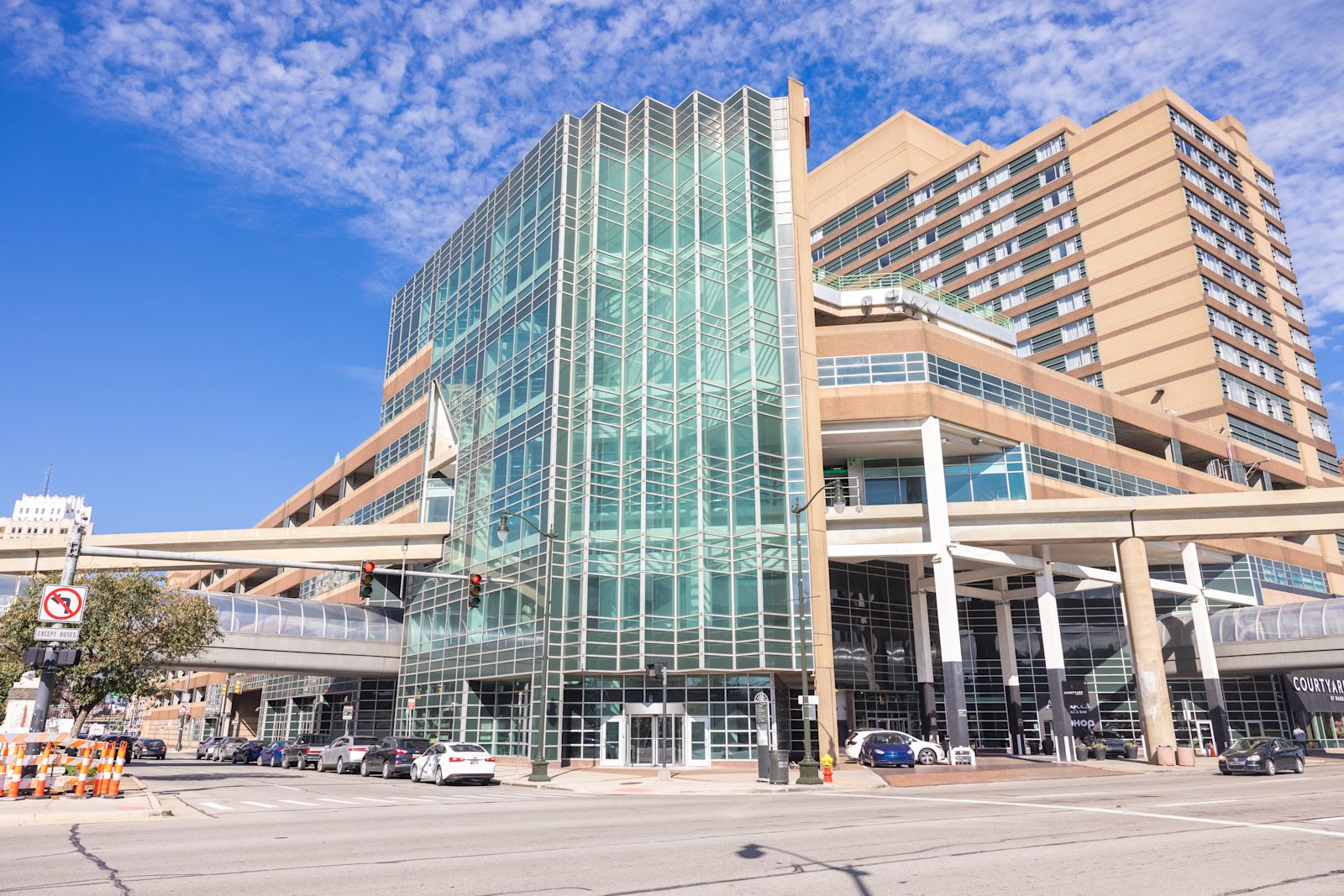
The last few shops inside the Millender Center have been told to clear out by the end of August.
Bedrock, the Dan Gilbert real estate firm that owns the complex, gave the remaining commercial tenants notice this spring. Only a handful of businesses are still operating in the seven-story retail atrium, among them a flower shop, a jewelry counter, a deli and a Christian Science reading room. Several have been in the building for decades. The order does not affect the apartment tower, which is separately owned, or the Courtyard by Marriott hotel.
The Millender Center opened in 1985 at 333 E. Jefferson Ave., on the eastern edge of downtown. It was built as a mixed-use complex: a residential tower, a hotel, a parking deck, a People Mover station and a ground-and-upper-level retail concourse, all stitched together by skywalks that cross Jefferson to the Renaissance Center and Randolph to the Coleman A. Young Municipal Center. Bedrock acquired the atrium and garage from General Motors in 2024.
The retail there has been fading for a while. By the tenants' accounts, the escalators have been out of service for more than a year and only one of the building's three public elevators has been running, which made the upper floors hard to reach and thinned out what foot traffic remained. "This has become an isolated corner, especially after COVID," Ashley Alexander, who runs Ashley's Flowers on the ground floor, told the Detroit Free Press.
What comes next is tied to the larger project across the street. Bedrock and GM have announced a $1.6 billion plan to remake the Renaissance Center, razing the two towers closest to the river, removing the podium at the base and converting the two towers nearest Jefferson into apartments. The skywalk linking the Millender Center to the RenCen is expected to be closed and partly torn down as part of that work. Bedrock has not laid out a specific plan for the Millender retail space itself.
For now the practical fact is the one the tenants are living with: a downtown complex that has anchored this stretch of Jefferson for forty years is emptying its storefronts, and the timeline points toward the bigger redevelopment reshaping the blocks around it.